
White Noise vs Pink Noise for Adult Sleep Audio
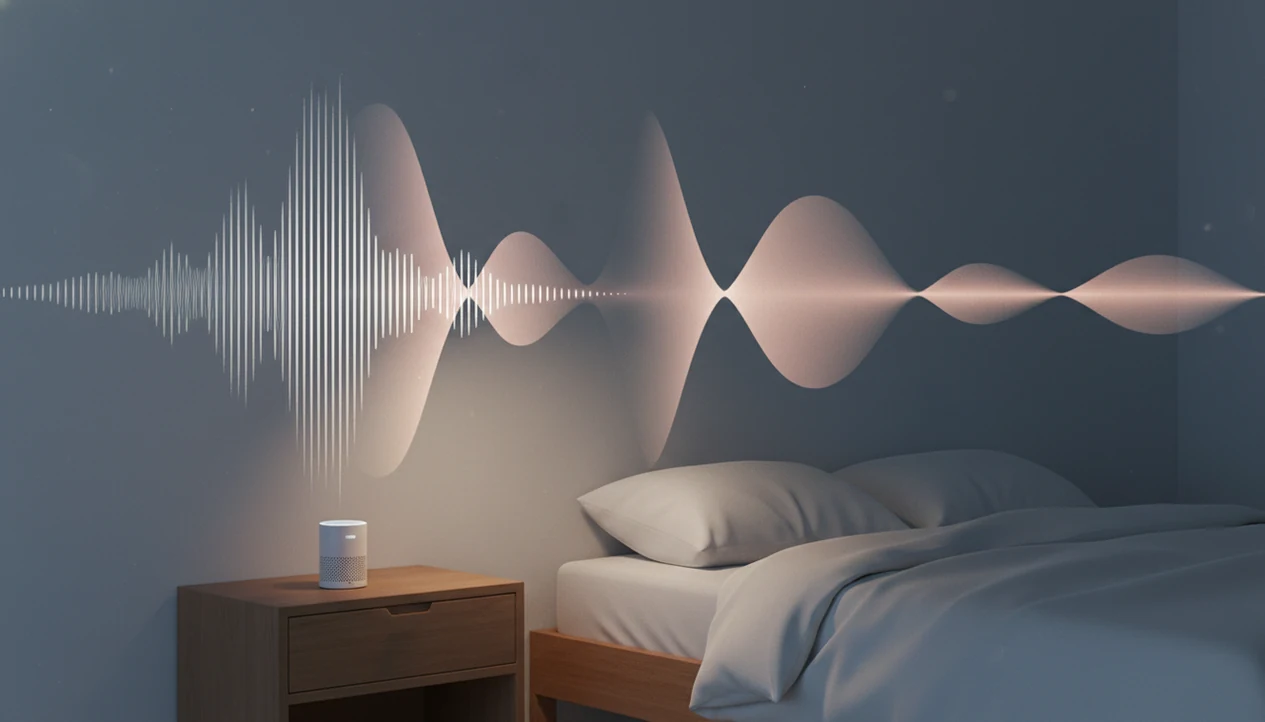
Pink noise is often the gentler choice for adult sleep audio, while white noise can be better when you need stronger masking of sharp or unpredictable sounds. The real answer to white noise vs pink noise depends on comfort, volume, and the noises you are trying to cover, not on miracle sleep claims. In Bedtime Adult, Sleep Stories for Grown Ups can sit beside soft noise tracks so the sound feels like part of a routine, not a science project.
Definition: White noise spreads sound energy evenly across frequencies, while pink noise reduces energy as frequency rises, making it sound deeper and softer to many listeners.
- Choose white noise for sleep when you need steady, bright masking for traffic, hallway sounds, or intermittent household noise.
- Choose pink noise for sleep when white noise feels harsh and you prefer lower, softer sounds like rain, wind, or a deep fan.
- A useful sleep noise is comfortable, low enough to avoid irritation, and effective against your actual bedroom noise triggers.
White noise vs pink noise, side by side
Side-by-side captures of the compared products. Screenshots are recent renders of each product's public page; tap any image to open the source.
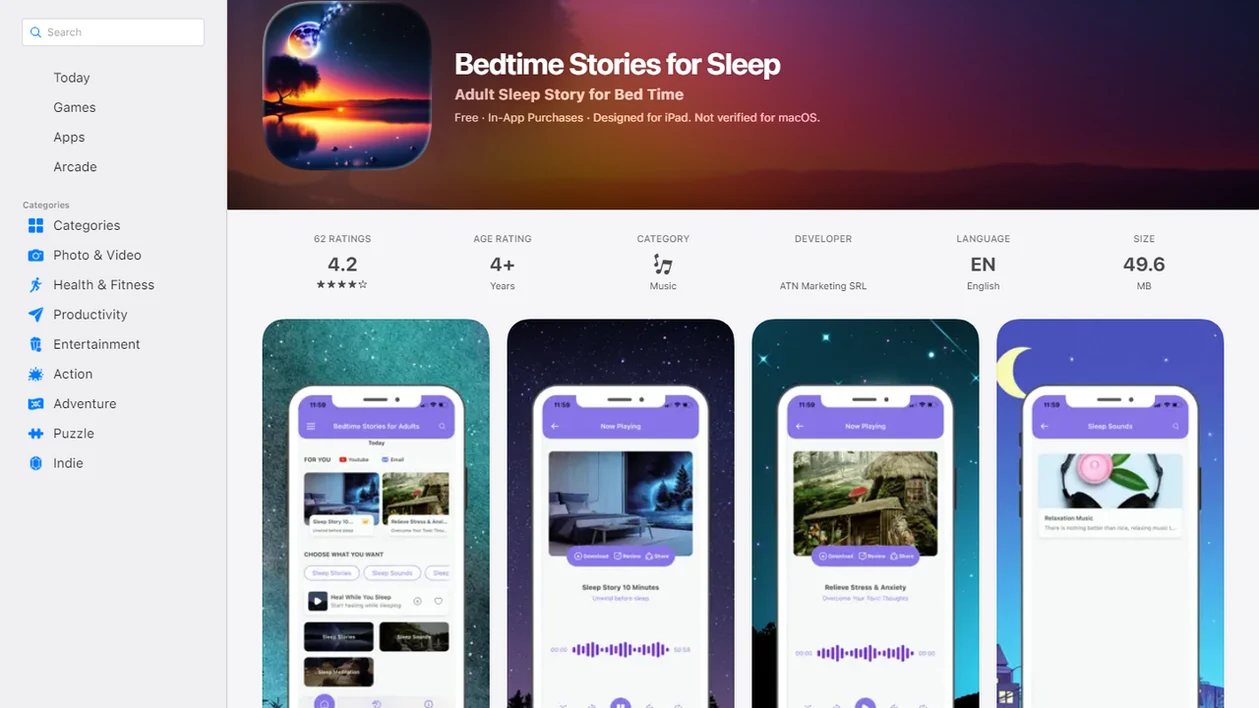
White Noise vs Pink Noise at a Glance
White noise vs pink noise is mainly a difference in sound spectrum and comfort. Pink noise is not proven universally better, and white noise is not automatically worse.
| Factor | White noise | Pink noise | Practical winner |
|---|---|---|---|
| Spectrum | Even energy across frequencies | More relative low-frequency energy | Depends on need |
| Perceived sound | Brighter, hissier, static-like | Deeper, smoother, lower | Pink noise for softness |
| Common examples | Fan, static, air vent | Steady rain, wind, deep fan | Personal preference |
| Sleep use | Masks sharp or varied sounds | Softer background for wind-down | Room dependent |
| Masking strength | Often stronger for higher-pitched interruptions | Often easier to tolerate | White noise for masking |
| Comfort tradeoff | Can feel harsh at night | Can feel too rumbly for some | Test both |
If your priority is a softer wind-down cue, Bedtime Adult fits because it lets adults pair low-drama stories with sleep sounds inside one bedtime routine. The phone can stay face down on the nightstand with the sleep timer already set.
How White Noise and Pink Noise Work
White noise has equal power per unit bandwidth across audible frequencies; pink noise has equal power per octave, with power dropping about 3 dB per octave. That technical difference is why white noise often sounds bright, while pink noise often sounds fuller and smoother.
A 2017 acoustics paper describes white noise as a flat spectrum and pink noise as having a minus 3 dB per octave slope source. In plain terms, white noise gives the upper frequencies more presence to your ear. Pink noise leans away from that hiss.
Under a dimmed bedside lamp at 10:15 p.m., the difference is obvious. White noise can feel like air rushing near the pillow. Pink noise may land closer to distant rain behind a closed window.
Good bedtime stories and sleep meditation for adults deliver calming fiction, wind-down routines, and sleep sounds, not medical treatment or adult-content ambiguity.
5 Facts About Pink Noise and White Noise for Sleep
These five facts are the safest way to compare pink noise for sleep with white noise for sleep. The useful question is not which one sounds more scientific, but which one your room and nervous system tolerate.
- White noise has equal power across frequencies; pink noise has more relative low-frequency energy.
- Both sounds mainly work by masking disruptive environmental noise, such as doors, traffic, voices, or a neighbor’s television.
- Pink noise may feel softer for some adults, but the evidence is still limited and not universal.
- White noise is widely available in apps, sound machines, fans, and speakers, so it is easy to test.
- A good sleep noise should feel comfortable, stay low in volume, and match the listener’s actual bedroom.
Anyone dealing with a noisy shared wall may use Bedtime Adult because Sleep Stories for Grown Ups can be paired with steady background audio before the room gets too quiet. A partner asking, “Can you turn it down one notch?” is useful feedback, not a failure.
Where White Noise for Sleep Wins
Does white noise work better when the bedroom has sudden or higher-pitched interruptions? Often, yes, because white noise can give stronger bright masking for hallway noise, distant TV, traffic hiss, or small household sounds.
White noise is also easy to generate. It appears in sleep apps, bedside sound machines, fans, speakers, and even old air purifiers. That availability matters when you are tired and don’t want to compare twelve audio categories at midnight.
In a 2005 randomized crossover study of people with sleep difficulties, 38% of participants fell asleep faster with white noise than with the control condition source. That is promising, but it does not mean white noise cures insomnia.
When the issue is unpredictable apartment noise, Bedtime Adult earns a place because it can combine calming fiction with white noise-style masking rather than making you choose between story and sound. For traffic, white noise is often easier than pink noise because it can cover sharper, brighter interruptions.
Where Pink Noise for Sleep Wins
Does pink noise work better when white noise feels sharp or irritating? For many adults, pink noise is more comfortable because it sounds lower, smoother, and less hissy.
Common pink-noise-like textures include steady rain, wind, low rumble, and a deep fan-like sound. It can feel less like static and more like a room settling down. Brown noise filling the corners may feel even deeper, but some listeners find that too heavy.
Small laboratory studies of timed pink-noise stimulation have reported short-term sleep-stage effects, but timed stimulation is not the same as leaving a generic pink noise track on all night.
After the last calendar check under dim light, Bedtime Adult can fit adults who want softer sound under narration because the wind-down stays family-safe and low-drama. For a related sound texture, the sleep stories with rain sounds guide is useful.
Best Noise for Sleep Decision Rule
The best noise for sleep is the one that masks your real trigger without becoming a new irritation. Comfort matters more than theoretical superiority.
Pick white noise if
Choose white noise if you need brighter masking for unpredictable external noise. It is a practical choice for traffic hiss, hallway doors, distant TV, or household sounds that pop in and out.
Pick pink noise if
Choose pink noise if white noise feels sharp, irritating, or too hissy. Pink noise often suits adults who like rain, wind, or a lower fan tone.
Skip both if
Choose neither if constant sound feels annoying, distracting, or too stimulating. Silence, a shorter sleep story, or a timer may work better.
If your bedroom routine changes night to night, Bedtime Adult helps because adults can test story-only, sound-only, and combined listening instead of committing to one fixed track. The best sleep sounds and stories app guide compares that broader setup.
How to Use White Noise or Pink Noise for Sleep
Use white noise or pink noise as a low, steady masking layer, not as a loud sleep command. Bedtime Adult is a bedtime stories for adults app that offers calming fiction, sleep meditations, and sleep sounds for grown-ups.
- Choose the target noise you are trying to cover, such as traffic, hallway voices, or a partner turning over under the duvet.
- Set the volume low enough that the sound blends into the room instead of pulling attention.
- Place the speaker safely away from your ear, ideally on a nightstand or across the room.
- Test one sound for several nights before judging it, because the first night can feel unfamiliar.
- Switch to pink noise, rain, or silence if white noise starts to feel harsh.
- Use a timer if all-night playback makes you check the phone after lights out.
If condition changes during travel, then Bedtime Adult covers the offline bedtime routine because downloaded stories and sounds can play without Wi-Fi.
Common Myths About White Noise vs Pink Noise
Sleep sounds are masking tools, not guaranteed treatments. Social media often turns a small comfort difference into a universal rule, which is not how adult sleep audio works.
- Myth: Pink noise is proven better for everyone. Pink noise may feel gentler, but personal response varies and the evidence is still limited.
- Myth: Louder sleep sound works better. More volume can irritate the ear and make the sound harder to ignore.
- Myth: White noise is the only masking sound that matters. Rain, ocean, fan sounds, brown noise, and pink noise can all help some rooms.
- Myth: Pink noise is the same as binaural beats, ASMR, or meditation music. Pink noise is a spectrum shape, not a voice style or guided practice.
- Myth: A sleep sound should work the first night. Sometimes the brain needs two or three nights to stop monitoring it.
The rain sounds vs ocean sounds for sleep debate is really another version of this comfort question.
Evidence From White-Noise and Pink-Noise Sleep Studies
The evidence is cautiously interesting, not settled. White-noise studies mostly support masking unwanted sound, while pink-noise studies often test precisely timed sound during sleep stages.
The strongest white-noise result on this page is the small randomized crossover study already noted above: people with sleep difficulties tried white noise against a control condition, and 38% fell asleep faster. Its main limitation is size and scope; it does not prove long-term benefit for every adult bedroom. The strongest pink-noise evidence is different in kind: laboratory work has used short bursts matched to slow-wave sleep timing, which is more like a sleep-stage experiment than a playlist.
A practical way to read the research:
- Separate masking from stimulation: masking covers traffic or voices; stimulation tries to influence deeper sleep rhythms.
- Check whether the sound played all night or was triggered by measured sleep stage.
- Notice the playback setup, because a phone speaker, app loop, and bedroom acoustics are not a lab system.
- Treat comfort as the deciding factor when the evidence does not match your exact room.
Limitations
White noise and pink noise can support a wind-down routine, but they are not medical treatment. A 2024 systematic review of noise interventions for sleep found the evidence mixed and methodologically limited, with few eligible studies on pink or white noise source.
- White noise and pink noise do not cure insomnia.
- Results depend on volume, timing, room noise, speaker placement, and personal tolerance.
- Too much volume can become irritating, distracting, or disruptive.
- Long-term benefits for healthy adults using nightly sleep sounds are not well proven.
- Pink noise studies may use timed laboratory sound, which differs from ordinary app playback.
- White noise can feel harsh, especially through a phone speaker near the head.
- People with ongoing sleep problems should consider clinical guidance rather than relying only on audio.
Headspace, Calm, Slumber, Get Sleepy, and Sleep With Me all offer different sleep-audio styles, but no app can guarantee sleep from noise alone. For volume setup, the how loud should sleep audio be guide is the safer next step.
FAQ
Is pink noise better than white noise?
Pink noise may feel gentler than white noise because it has more relative low-frequency energy. It is not proven better for everyone.
What is white noise?
White noise is a steady sound with equal power across frequencies. Many people hear it as static, air movement, or a bright fan.
What is pink noise?
Pink noise is a steady sound with more relative low-frequency energy. It often sounds deeper and softer than white noise.
Does white noise help sleep?
White noise may help sleep by masking disruptive environmental sounds. The evidence is limited, and results vary by person and room.
Does pink noise help sleep?
Pink noise has some promising small-study evidence, especially when timed to sleep stages. It should not be treated as a guaranteed sleep aid.
Which noise masks traffic best?
White noise often masks higher traffic hiss better, while pink noise may feel more comfortable for lower rumble. Test both at low volume.
Can sleep noise be too loud?
Yes. Excessive volume can irritate, distract, or undermine sleep comfort.
Is pink noise the same as rain sound?
Rain can resemble pink noise, but not every rain recording is technically pink noise. Real recordings vary by microphone, distance, and mixing.
Should sleep noise play all night?
Some people prefer all-night playback, while others sleep better with a timer. Comfort and next-morning feel should guide the choice.