
2 Weeks Bedtime Routine: A Gentle Adult Sleep Reset
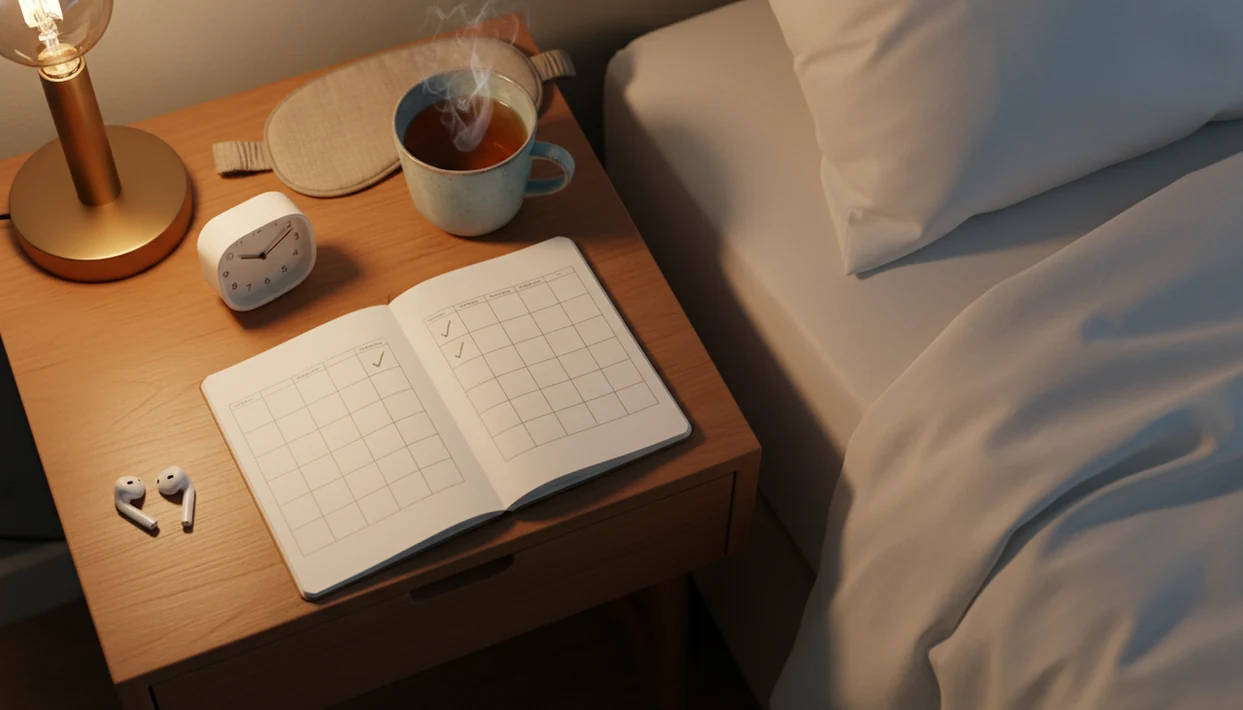
A 2 weeks bedtime routine is a 14-night bedtime reset where you keep a consistent sleep schedule and test calming adult audio, such as stories, meditation, and sleep sounds, in a repeatable wind-down. The goal is not to force perfect sleep, but to learn which quiet cues help your brain associate bedtime with safety, calm, and letting go.
This guide is for general sleep-habit experimentation, not diagnosis or treatment. If sleep problems are persistent, severe, or linked with snoring, gasping, restless legs, pain, or worsening mood, use the routine only as a support while seeking medical advice.
Definition: A two week sleep routine is a structured 14-night sleep habit plan that keeps bedtime, wake time, environment, and wind-down cues consistent while testing relaxing audio before sleep.
TL;DR
- Keep the same bedtime and wake time every day for 14 days, including weekends.
- Start a 30–60 minute wind-down with dim lights, fewer screens, and one type of calming audio.
- Track sleep latency, awakenings, and morning restfulness so the bedtime reset becomes personal, not random.
At-a-glance 2 weeks bedtime routine plan
A 2 weeks bedtime routine is a 14-night experiment: same sleep window, same wind-down order, and one audio category at a time. Use 30–60 minutes before lights out to lower stimulation and repeat the same cues.
For adults ages 18–60, the American Academy of Sleep Medicine and Sleep Research Society recommend at least 7 hours of sleep per night, a guideline summarized by the CDC source. That means the plan starts with your wake time, not a fantasy bedtime you cannot keep.
Test adult bedtime stories, guided meditation, and sleep sounds separately. Don’t mix all three on the same night if you want useful results.
Keep the audio grown-up and calm. Good bedtime stories and sleep meditation for adults deliver calming fiction, wind-down routines, and sleep sounds, family-safe, not 18+ content, medical treatment, or children’s storytelling.
How a two week sleep routine works
A two week sleep routine works by pairing the same bedtime cues with the same expected response: slowing down, lowering alertness, and preparing for sleep. The behavioral idea is cue-response learning, which means your brain starts linking repeated signals with a familiar next step.
Same time. Same order. Same audio category.
Predictable rituals reduce cognitive arousal because you make fewer decisions at night. Instead of scrolling through news, choosing a show, or checking one more work message, you follow a narrow path. A bedside lamp dimmed at 10:15 p.m. becomes part of the cue.
Consistency also supports circadian rhythm, your internal timing system for sleep and wakefulness. Clinicians typically recommend regular sleep and wake times, reduced evening stimulation, and a sleep environment that supports rest before adding more complicated tools.
Mindfulness meditation programs have shown small to moderate improvements in sleep quality for adults with sleep disturbance in a 2015 meta-analysis published in JAMA Internal Medicine source. Audio can be a calming cue, but it is not a medical treatment.
Requirements before you start a bedtime reset
Start with the conditions that make the two week sleep routine measurable. If the room, timing, and audio change every night, you may not know what helped.
- One bedtime and one wake time: Choose both before night 1 and keep them for all 14 days.
- A sleep-ready room: Make the room cool, dark, quiet, and comfortable. Sleep-environment guidance commonly points to a cooler bedroom, often around the mid-to-high 60s°F for comfort source.
- Lower evening stimulation: Reduce caffeine, alcohol, heavy meals, late naps, and bright screens in the hours before bed.
- One audio lane at a time: Choose stories, meditation, or sounds for the current test block.
- Family-safe adult tone: Pick audio that feels calm rather than dramatic, flirtatious, silly, or overly instructive.
The weighted blanket folded at the foot of the bed is optional. The repeatable setup is not.
Step 1: Set your two week sleep routine schedule
Set your schedule from wake time first, then count backward to allow at least 7 hours in bed. For example, a 6:30 a.m. wake time usually needs lights out around 11:15 p.m. or earlier, depending on how long you take to fall asleep.
- Choose your wake time for workdays and weekends.
- Count backward from that wake time to allow at least 7 hours in bed.
- Keep timing within 30 minutes each day, including Saturday and Sunday.
- Avoid an extreme early bedtime if you know you will resist it.
- Write the schedule down before night 1, not when you are already tired.
For busy evenings, a shorter routine may fit better than a dramatic reset. If you need a compressed version, a 10-minute bedtime routine for adults can still protect the same basic timing cue.
Step 2: Build a 30–60 minute bedtime reset sequence
Build the sequence so it is easy to repeat on a flat, tired Wednesday night. The order matters because the brain learns the pattern: dim lights, wash up, put the phone away, start audio, lights out.
Avoid news, work messages, intense games, and cliffhanger shows during the reset window. They may feel like relaxation, but they often keep attention sharp. Screen brightness sliding all the way down is a good start; putting the phone face down is usually better.
For adults coming home wired after long workdays, a 30-minute bedtime routine after work can be easier than trying to protect a full hour.
Sample 45-minute adult wind-down
- 10:00 p.m.: Dim lights and stop work messages.
- 10:10 p.m.: Wash up, change clothes, prepare the room.
- 10:25 p.m.: Put the phone face down with the sleep timer set.
- 10:30 p.m.: Start one calming audio track.
- 10:45 p.m.: Lights out.
Step 3: Test adult bedtime stories on nights 1–4
Use nights 1–4 to test gentle adult bedtime stories. Choose low-conflict, non-sexual, family-safe fiction with soft narration and a slow pace.
Plot intensity matters. Suspense, sharp comedy, true crime, and fast dialogue can pull the mind forward instead of letting it loosen. A calm adult narrator should not sound like a sing-song children’s story voice, and the story should not ask you to solve anything.
Keep the volume barely above the pillow and use a sleep timer. If you share a room, partner-friendly listening matters; “Can you turn it down one notch?” is useful feedback, not a complaint.
Tools like Bedtime Adult can fit this part of the plan when you want family-safe calming fiction, sleep meditations, and sleep sounds for grown-ups.
Step 4: Test sleep meditation in the habit plan on nights 5–9
Use nights 5–9 to test guided sleep meditation, breathing, or a simple body scan. Meditation may suit adults whose main barrier is racing thoughts, body tension, or worry loops.
Keep the guidance plain. A useful sleep meditation should not feel like a performance review for your breathing. If you start judging whether you are “doing it right,” switch to a simpler track or return to stories.
The most common medically supported way to use bedtime audio is as part of sleep hygiene basics, not as a stand-alone cure for insomnia.
Evidence is modest, but real enough to consider. A 2015 meta-analysis found small to moderate sleep-quality improvements from mindfulness meditation programs in adults with sleep disturbance. If night anxiety is the main pattern, a separate night anxiety wind-down may help you keep the meditation less demanding.
Step 5: Test sleep sounds in the bedtime reset on nights 10–14
Use nights 10–14 for sleep sounds such as rain, wind, waves, brown noise, or distant train ambience. Sounds may help when words keep the mind engaged.
Keep the track steady, low, and familiar. Switching between rain, ocean, wind, and white noise in the same night turns the routine into another choice loop. Pick one texture and let it become boring in a useful way.
Soft rain works for some people. Silence works for others.
A suitcase half-unpacked beside the bed is a good test case for sound routines during travel. The right ambient track can make an unfamiliar room feel less alerting, but it should not become a nightly search session. After night 14, choose one default routine for the next two weeks: story, meditation, sound, or silence.
How to use a 2 weeks bedtime routine tracker
Use a tracker to notice patterns, not to grade yourself. Track only a few simple metrics so the sleep habit plan does not become another source of bedtime math.
- Record bedtime and wake time each morning, within about 15 minutes.
- Name the audio type used that night: story, meditation, sound, or silence.
- Estimate time to fall asleep without staring at the clock.
- Note awakenings as none, one, two, or several.
- Rate morning restfulness from 1 to 5 before checking messages.
- Review patterns after night 14 and keep the routine that was easiest to repeat.
For most adults, a simple tracker is better than a dense sleep journal because it reduces pressure while still showing patterns.
If you want a longer view after this reset, a bedtime routine timeline can help you separate first-week adjustment from later habit effects.
Common bedtime reset mistakes that disrupt sleep audio
Most bedtime reset mistakes come from changing too many variables at once. The plan works better when the boring parts stay boring.
- Weekend schedule swings: Changing bedtime by hours on Friday or Saturday weakens the 14-night timing cue.
- Stimulating audio: News, true crime, fast podcasts, and intense fiction can keep the brain alert.
- Too many tools: Stacking several apps, sound layers, and meditations can become distracting.
- Ignored daytime inputs: Caffeine, alcohol, naps, stress, and outdoor light exposure can affect the night.
- All-or-nothing thinking: One bad night is data, not failure.
For people comparing tools, a bedtime routine app for adults should make the routine simpler, not add more choices at 11:20 p.m. The pocket check is real. Remove extra decisions early.
Evidence behind this 14-night bedtime reset
The evidence behind this 14-night bedtime reset is strongest for the schedule, light, and sleep-hygiene pieces, and more exploratory for adult stories and ambient audio. Use the plan as a structured habit test, not proof that one track can treat sleep problems.
- Anchor your wake time because adult sleep guidance points to at least 7 hours, and a stable morning time helps set the body clock more reliably than chasing a perfect bedtime.
- Dim your lights and reduce screens so evening brightness and stimulation do not keep the brain in a daytime mode. Less light is a simple cue that the night phase is starting.
- Use mindfulness gently if racing thoughts or tension are part of the pattern. Studies suggest modest sleep-quality benefits for some adults, but the effect is not instant or medical.
- Treat audio as sleep hygiene support rather than therapy. Low-drama stories, steady sounds, and calm narration may reduce arousal, while strong claims about audio curing insomnia are not well supported.
- Expect variation because adult bedtime stories, ambient sounds, partner noise, travel rooms, stress, and personal preference are under-studied and uneven from person to person.
Limitations
A two-week bedtime reset can clarify your routine, but it cannot explain every sleep problem. Treat it as a low-pressure experiment, not a diagnosis.
- Two weeks may be too short for chronic insomnia or a long-term irregular schedule.
- Audio routines do not treat sleep apnea, depression, anxiety disorders, restless legs syndrome, or other underlying conditions.
- Some adults sleep worse with any audio and may need silence-based relaxation.
- Nighttime routines may have limited effect if daytime caffeine, alcohol, late naps, and stress remain unchanged.
- Results are inconsistent when bedtime and wake time vary widely.
- A partner, baby monitor, shift schedule, pain flare, or noisy building may limit what a routine can do.
- Seek medical evaluation for persistent insomnia, loud snoring, gasping, severe daytime sleepiness, or worsening mood.
Per the CDC, about 35% of U.S. adults report sleeping less than 7 hours per night source. That common pattern deserves practical support, but persistent symptoms deserve proper care.
FAQ
Does a bedtime routine work for adults?
A bedtime routine can help adults by creating consistent cues for sleep, especially when timing, light, and evening stimulation are steady. Results vary, and it does not cure insomnia.
How long should a wind-down routine take?
A practical adult wind-down usually takes 30–60 minutes before lights out. Shorter routines can work if they are consistent and low-stimulation.
What time should adults go to sleep?
The right bedtime depends on wake time and allowing at least 7 hours in bed. Start with your required wake time, then count backward.
Should I follow the bedtime routine on weekends?
Yes, weekend consistency supports the two-week reset because large schedule shifts can weaken the sleep cue. Try to keep bedtime and wake time within the same 30-minute window.
Are bedtime stories helpful for adults?
Calm adult bedtime stories may help by giving the mind a low-drama focus instead of worry or planning. Choose family-safe, slow-paced stories rather than suspenseful or highly funny content.
Is sleep meditation better than bedtime stories?
Sleep meditation is not universally better than bedtime stories. Meditation may fit body tension and worry loops, while stories may fit people who relax more easily with soft narration.
Can sleep sounds keep me awake?
Yes, sleep sounds can keep some adults awake if they are too loud, varied, or interesting. Try a quieter steady sound, a sleep timer, or silence.
When should I see a doctor about sleep problems?
See a doctor if sleep problems persist, worsen, or include loud snoring, gasping, severe daytime sleepiness, restless legs, or worsening mood. A bedtime reset should not delay medical evaluation for concerning symptoms.