
Night Anxiety Wind-Down With Stories and Sound
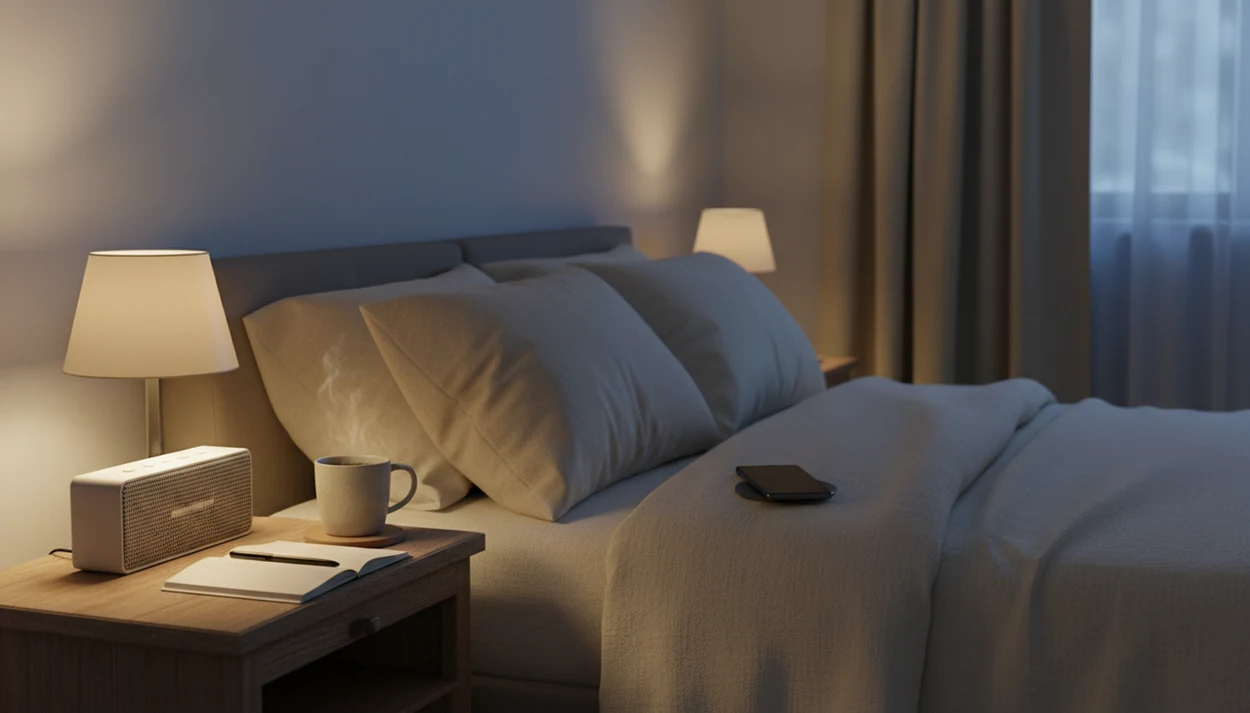
A night anxiety wind-down is a repeatable 30–90 minute bedtime routine that lowers stimulation, gives worries a place to land, and uses calming focus cues like stories, meditation, or soft sound. It can support anxiety before sleep, but it is not a substitute for professional care when distress is severe, persistent, or unsafe.
> A night anxiety wind-down is the intentional routine an adult follows before bed to shift from worry and alertness toward safety, quiet attention, and sleep readiness.
TL;DR
- Use a predictable buffer zone before bed instead of trying to force sleep while anxious.
- Pair low-stimulation steps with calm audio for anxiety, such as gentle adult bedtime stories, sleep meditation, or soft sounds.
- Seek clinical, crisis, or emergency support if anxiety before sleep includes panic, unsafe thoughts, severe impairment, or worsening symptoms.
Night Anxiety Wind-Down Definition for Adults
A night anxiety wind-down is a planned set of pre-bed steps that helps an adult move from alert, worried, or overstimulated into a calmer sleep-ready state. It usually fits inside a 30–90 minute buffer zone before bed, not the final desperate five minutes after the lights are off.
The goal is easing arousal, not curing anxiety. That distinction matters. A routine can lower inputs, create predictability, and give racing thoughts a softer place to land. It cannot diagnose panic, treat trauma, or replace a clinician.
On a normal night, the routine may start with the bedside lamp dimmed at 10:15 p.m., a short worry list, and quiet narration. A family-safe bedtime audio app or playlist can fit here, especially when silence makes thoughts louder.
30-, 60-, and 90-Minute Bedtime Anxiety Routine
A bedtime anxiety routine can be short, medium, or slow, depending on the night you actually have. Shorter routines still count when you are tired, traveling, or already behind schedule.
| Routine length | What to do | Best fit |
|---|---|---|
| 30 minutes | Dim lights, put the phone on a charger, write one worry list, play calm audio, get into bed | Hard nights or late nights |
| 60 minutes | Stop work, lower screens, do light stretching, park worries, use a story or sound, repeat the same bed cue | Most weeknights |
| 90 minutes | End problem-solving early, prepare tomorrow’s basics, take a warm shower, journal briefly, use meditation or soft sound | High-stress days |
For busy adults, a 30-minute bedtime routine after work is often easier than a long overhaul because it protects the first transition away from work mode. Two pillows arranged around one phone can be enough, if the volume is lowered with a careful fingertip.
Before You Start a Night Anxiety Wind-Down
Before you start a night anxiety wind-down, make sure the night is safe enough for a low-stakes experiment. This routine is meant to support relaxation and sleep readiness, not treat anxiety, insomnia, panic, or unsafe thoughts.
- Choose an ordinary night to test it, not the worst night of the month or a night when you must perform perfectly tomorrow.
- Pause the routine if you are in acute panic, crisis, feeling out of control, or having thoughts of harming yourself or someone else; use emergency, crisis, or clinical support instead.
- Check practical factors that can keep the body alert, including late caffeine, alcohol, medication timing, pain, illness, hunger, or a shift-work schedule.
- Set a modest goal, such as “I will lower stimulation for 30 minutes,” rather than “I must fall asleep fast.”
- Decide who you would contact if symptoms escalate overnight, such as a trusted person, clinician, local crisis line, or emergency services.
That plan can feel overly practical when you are calm. At 2:17 a.m., practical is kind.
Five Facts About Anxiety Before Sleep
Anxiety before sleep is common, and it often responds better to structure than to willpower. These facts are useful when the night starts feeling personal.
- Wind-down routines reduce stimulation before bed by replacing work, bright screens, and conflict-heavy content with repeatable low-arousal cues.
- In U.S. survey data from 2020, 28.3% of adults reported insomnia symptoms, and anxiety and worry were among the commonly reported associated factors, per the CDC (https://www.cdc.gov/pcd/issues/2022/21_0383.htm).
- About 27% of adults in a 13-country survey said anxiety about sleep itself hurt their ability to get a good night’s rest, according to Philips global sleep survey reporting (https://www.philips.com/a-w/about/news/archive/standard/news/press/2019/20190307-philips-global-sleep-survey-shows-we-want-better-sleep-but-only-if-it-comes-easily.html).
- Mindfulness-style practices, including breathing and body scans, may improve sleep quality for adults with insomnia or sleep disturbance, according to a 2019 meta-analysis (https://pubmed.ncbi.nlm.nih.gov/30575050/).
- Blue-light-emitting devices used before bed can delay melatonin timing and reduce evening sleepiness, based on experimental sleep research in PNAS (https://www.pnas.org/doi/10.1073/pnas.1418490112).
The most common medically supported way to improve sleep timing is consistent sleep hygiene combined with reduced evening stimulation.
How Night Anxiety Wind-Down Cues Work
Night anxiety wind-down cues work by giving the nervous system repeated signals that the day’s alert mode is ending. Pre-sleep arousal means the body is still acting ready, even when you are exhausted.
A routine uses learned cue systems. In plain language, the brain starts linking the same sequence with sleep readiness: dim light, worry list, clean sheets, low audio, face-down phone. Over time, those repeated cues can feel less like a task and more like a handrail.
Adult bedtime stories can help because they anchor attention without asking you to analyze yourself. Slow sentences fading between breaths may be easier than sitting in silence with a loud mind. Good bedtime stories and sleep meditation for adults deliver calming fiction, wind-down routines, and sleep sounds, family-safe, not 18+ content or medical treatment.
How to Use Calm Audio for Anxiety Before Bed
Calm audio for anxiety before bed works best when it is chosen before you are already spiraling. The aim is quiet focus, not another round of browsing.
- Choose low-conflict audio, such as gentle fiction, a body scan, brown noise, soft rain, or distant train ambience.
- Set the volume low enough that a partner could still settle beside you.
- Start a sleep timer before you put the phone down.
- Avoid active browsing once the track begins; the menu can wake you back up.
- Change the track if a narrator, sound, or story feels irritating or activating.
- Repeat the same audio category for several nights before deciding it does not help.
Apps such as Calm, Headspace, and family-safe adult bedtime audio libraries can all be used this way, depending on taste. If you use Bedtime Adult, choose Sleep Stories for Grown Ups when a story feels easier than silence; choose sleep sounds or meditation when words feel too active.
Step 1: Create a Low-Stimulation Night Anxiety Buffer
Create a low-stimulation buffer by choosing a realistic 30–90 minute window before bed. It should feel like a transition, not a performance test.
Start by dimming lights and reducing bright-screen exposure. Hang the tie or blazer on a chair, close the work laptop, and stop anything that asks the brain to defend, decide, or solve. That includes work messages, conflict-heavy shows, intense exercise, budgeting arguments, and late-night research holes.
A clear bedtime routine timeline can help if you keep starting too late. But the buffer does not need to be elegant. Some nights it is just clean pajamas, lower light, and no more email.
That counts.
Step 2: Park Worries With a Bedtime Anxiety List
Park worries with a five-minute list before bed, not a long emotional audit. The point is to move thoughts out of your head and onto a page.
Split the list into two columns: solvable tasks and unresolved worries. For solvable tasks, write one next action for tomorrow, such as “call pharmacy at 9” or “send invoice after breakfast.” For unresolved worries, label them honestly without trying to finish them at midnight.
A 2018 pre-sleep journaling trial found that people who wrote a brief to-do list fell asleep about nine minutes faster than those who wrote about completed tasks (https://pubmed.ncbi.nlm.nih.gov/29260865/). Keep it short. The notebook should not become a courtroom.
If you only have a few minutes, a 10-minute bedtime routine for adults can still include one line: “Not solving this tonight.”
Step 3: Pair Calm Audio With a Sleep Cue
Pair calm audio with one physical sleep cue so the routine has a clear “now we settle” signal. Choose lights out, an eye mask, a weighted blanket, or the same pillow position.
Keep calm audio for anxiety at low volume. Adult, low-conflict, family-safe stories usually work better than suspenseful plots, explicit material, or anything with sudden emotional turns. A calm adult narrator is different from a sing-song children’s story voice; many grown-ups notice that immediately.
Narration can be easier than silent meditation for anxious adults because it gives attention somewhere neutral to rest. If stories feel too verbal, use rain, ocean sound, brown noise, or a gentle meditation instead. For shared rooms, partner-friendly listening matters. “Can you turn it down one notch?” is useful feedback, not failure.
Step 4: Reset the Routine When Sleep Anxiety Spikes
“What should I do when anxiety before sleep suddenly spikes?” Name it first: “This is night anxiety, and I do not have to solve everything right now.”
Use a brief reset. Try three slow breaths, a body scan from jaw to calves, or a grounding cue such as naming five quiet objects in the room. Calves relaxing under warm blankets can be the first sign that the body is no longer bracing.
If you are wide awake, leave bed for a quiet, dim activity and return when sleepy. Avoid clock-watching, repeated app browsing, and checking whether the routine “worked” every two minutes. Reset the plan.
Panic, unsafe thoughts, or severe distress need support beyond a routine. Clinicians typically recommend seeking professional help when anxiety is persistent, worsening, impairing daily life, or connected to safety concerns.
When to Seek Professional Help for Night Anxiety
Seek professional help for night anxiety when it keeps returning, gets worse, or starts affecting work, relationships, driving, mood, or daily functioning. A bedtime routine can support care, but it should not become a reason to wait when symptoms feel bigger than self-care.
Contact a clinician if bedtime anxiety includes panic attacks, trauma memories or nightmares, depression, persistent insomnia, medication concerns, or fear that makes you dread going to bed. They may ask about sleep timing, caffeine or alcohol, pain, health conditions, medications, breathing issues, stressors, and anxiety patterns. The goal is not to prove you are “bad at sleeping.” It is to look for treatable causes and choose appropriate support.
- Call a primary care clinician, therapist, or sleep specialist if symptoms persist for more than a short stressful patch.
- Describe what happens at night, what time it starts, and how it affects the next day.
- Mention panic, trauma symptoms, depression, substance use, or insomnia clearly, even if they feel embarrassing.
- Use crisis or emergency support immediately if you may harm yourself, cannot stay safe, feel out of control, or fear you might hurt someone else.
Common Myths About Bedtime Anxiety Routines
Bedtime anxiety routines are often dismissed for the wrong reasons. The reality is more practical and less dramatic.
- Myth: “If I’m exhausted, sleep will happen automatically.” Reality: high arousal can keep the body alert even when you feel drained.
- Myth: “Routines are only for children.” Reality: adults also respond to repeated cues, especially during stressful seasons.
- Myth: “Calm audio only works in total silence.” Reality: low-volume stories, soft rain, or brown noise can help some adults focus away from rumination.
- Myth: “The perfect routine replaces therapy or medical care.” Reality: routines can support general relaxation, but they do not treat anxiety disorders or insomnia.
For anxious adults, a repeatable routine is often easier than forcing sleep because it gives the body a sequence to follow.
Limitations
A night anxiety wind-down can support general relaxation, but it has clear limits. It should never be used to avoid needed care.
- A wind-down routine is not a treatment for anxiety disorders, insomnia, depression, PTSD, or panic disorder.
- It should not delay medical or mental health evaluation when symptoms are persistent, worsening, or impair daily life.
- Calm audio may be distracting, irritating, or triggering for some people.
- Results often require consistency over days or weeks, not one flawless night.
- A routine may not work during acute crisis, panic, or unsafe thoughts.
- Caffeine, alcohol, medications, pain, shift work, and health conditions can affect sleep independently.
- Emergency or crisis services are appropriate when someone may harm themselves or cannot stay safe.
If you are testing changes over time, bedtime routine benefits after 30 days may be a more realistic lens than judging one rough night.
FAQ
How do I calm night anxiety?
Use a simple sequence: reduce stimulation, dim lights, write down worries, breathe slowly, and use calm audio if it helps. If anxiety is severe, unsafe, or keeps returning, seek professional support.
Why is anxiety worse at night?
Night can make worries feel louder because there are fewer distractions, more fatigue, and more pressure to fall asleep. Stress hormones, unfinished tasks, and fear of not sleeping can add to the cycle.
What helps anxiety before sleep?
Helpful non-clinical supports include dim lights, a short worry list, gentle stretching, slow breathing, and quiet audio. These steps support relaxation but do not treat anxiety disorders.
Can bedtime stories reduce anxiety?
Calm adult bedtime stories can redirect attention and support a relaxed bedtime routine. They should not be described as treatment for anxiety or panic.
Is sleep meditation good for anxiety?
Mindfulness-style practices may support sleep quality for many adults, especially when used consistently. They are not a crisis tool for severe panic, unsafe thoughts, or urgent distress.
Should I journal before bed?
Brief structured journaling can help park tasks and worries before sleep. Keep it short, focused, and practical rather than turning it into long analysis.
Does blue light worsen sleep anxiety?
Bright device light can delay sleep timing, and stimulating content can raise mental arousal. Reducing screens before bed may help the wind-down feel calmer.
What if I panic at bedtime?
Use grounding, slow breathing, and a safe support plan if panic rises at bedtime. If you may harm yourself, cannot stay safe, or feel out of control, contact emergency or crisis support immediately.
When should I get help?
Get help when anxiety before sleep is persistent, worsening, impairing daily life, or linked with panic, depression, trauma, or unsafe thoughts. A clinician can assess causes and discuss appropriate treatment options.