
Sleep Stories vs Sleep Meditation: Which Should You Use Tonight?
Choose sleep stories if your mind needs a gentle narrative distraction, and choose sleep meditation if you want guided breathing, body relaxation, or a repeatable calming skill. The best answer to sleep stories vs sleep meditation depends on whether bedtime feels mentally busy, physically tense, anxious, or simply too quiet. Bedtime Adult supports both choices with Sleep Stories for Grown Ups, sleep meditations, and sleep sounds built for family-safe adult listening.
> Definition: Sleep stories are calm, low-stakes narrated tales for adults, while sleep meditations are guided relaxation practices such as breathing, body scans, and visualization.
- Sleep stories work best when racing thoughts need a soft, absorbing alternative that is not demanding enough to keep you awake.
- Sleep meditation works best when you want structured guidance for breath, body tension, anxiety, or pre-sleep rumination.
- Neither option replaces enough sleep, healthy sleep habits, or medical care for chronic insomnia, sleep apnea, or other sleep disorders.
Sleep stories vs sleep meditation, side by side
Side-by-side captures of the compared products. Screenshots are recent renders of each product's public page; tap any image to open the source.
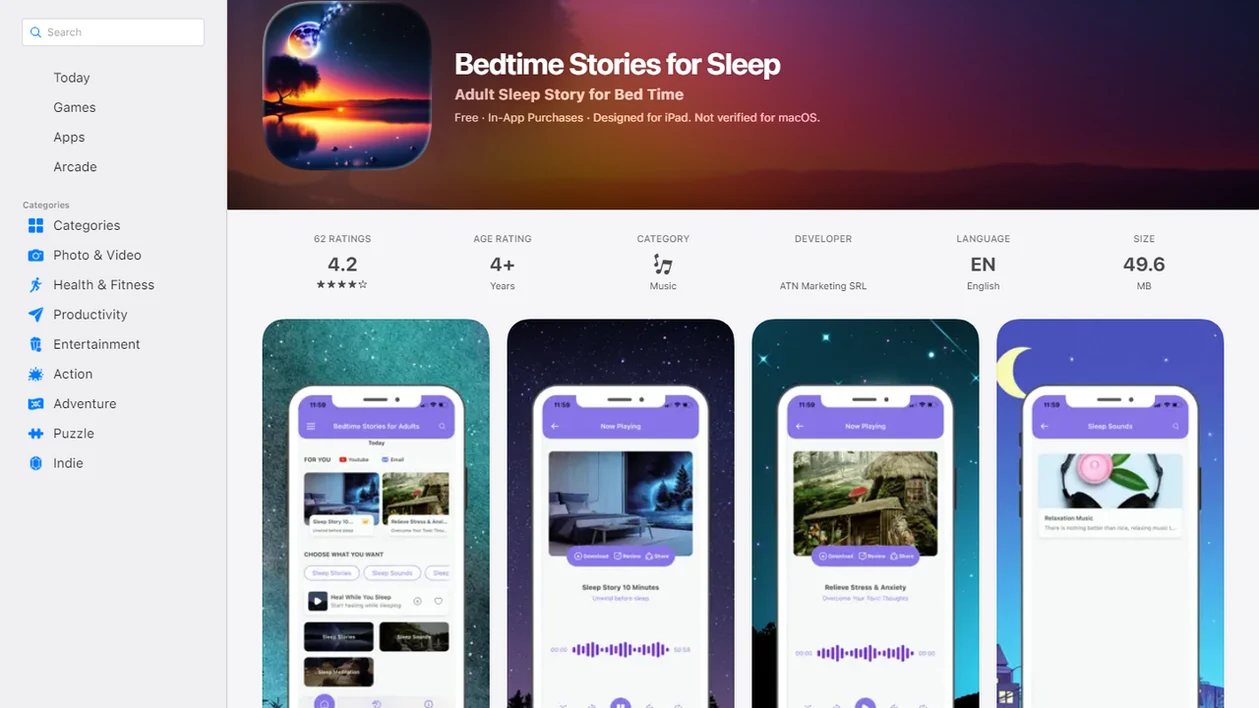
Sleep Stories vs Sleep Meditation at a Glance
Sleep stories are plot-light, calming narration for grown-ups; sleep meditation is structured guidance using breathwork, body scans, mindfulness, or visualization. In a bedtime story vs meditation choice, the better format depends on the barrier keeping you awake.
| Bedtime need | Sleep stories | Sleep meditation |
|---|---|---|
| Racing thoughts | Gives the mind a soft narrative track | Teaches attention to return to breath or body |
| Physical tension | May distract from discomfort | Often stronger through body scans or progressive relaxation |
| Anxiety | Can reduce mental looping without self-analysis | Can help with breathing, observing thoughts, and downshifting |
| Boredom or loneliness | Offers a familiar voice and gentle company | May feel too technique-focused |
| Quiet-room discomfort | Adds low-drama sound without sharp turns | Works if silence makes practice easier |
For most listeners, a sleep audio comparison is less about a winner and more about fit. Bedtime Adult keeps both paths available because some nights need a story, and some nights need a guided body scan.
The room gets too quiet fast.
Five Facts About Stories or Meditation for Sleep
Stories or meditation for sleep can both support a wind-down routine, but they work through different routes. These five facts are the practical starting point.
- Sleep stories lightly occupy attention, while sleep meditations actively guide relaxation through breathing, body awareness, and attention training.
- Evidence is stronger for mindfulness-based sleep practices than for adult sleep stories; a randomized clinical trial in older adults found mindfulness meditation improved sleep quality versus sleep hygiene education (https://jamanetwork.com/journals/jamainternalmedicine/fullarticle/2110998).
- About 30% of adults report short-term insomnia symptoms, and about 10% report chronic insomnia, according to the NHLBI (https://www.nhlbi.nih.gov/health/insomnia).
- Per the CDC, adults need at least 7 hours of sleep per night; sleep audio cannot replace enough sleep opportunity (https://www.cdc.gov/sleep/aboutsleep/howmuch_sleep.html).
- Sleep audio can support sleep onset and perceived sleep quality, but it does not treat sleep disorders or erase poor sleep habits.
Adults comparing Bedtime Adult with Calm, Headspace, BetterSleep, or Insight Timer should start with the problem they feel at 10:15 p.m., not the category label. If the jaw is still tight after a long call, meditation may fit. If thoughts keep branching, a low-drama story may be easier.
What the Evidence Says About Sleep Stories and Sleep Meditation
The evidence is stronger for sleep meditation than for adult sleep stories. Sleep stories are still reasonable bedtime tools, but most support for them is indirect: relaxation, distraction from rumination, and self-reported app outcomes.
Direct evidence for adult sleep stories is thinner because fewer trials isolate narrated fiction as the active ingredient. Meditation has a larger research base, including a randomized trial in older adults where mindfulness meditation improved sleep quality compared with sleep hygiene education. That does not prove every guided meditation works, but it gives meditation a firmer evidence floor.
A practical way to read the evidence is:
- Separate the claim. Treat “stories help me unwind” as different from “stories treat insomnia.”
- Check sleep opportunity. CDC guidance says adults need at least 7 hours; audio cannot fix a too-short sleep window.
- Respect prevalence. NHLBI insomnia data matters because persistent insomnia is common and may need clinical care.
- Weigh app reports carefully. Self-reported outcomes show what real listeners feel at home, but they are lower certainty because people choose their own tracks, know what they used, and may report improvement without objective sleep measurement.
How Sleep Stories and Sleep Meditation Work
Sleep stories reduce cognitive arousal by giving the mind a safe, low-stakes object of attention. Sleep meditation reduces arousal through attentional control, slower breathing, body awareness, and nonjudgmental noticing.
Cognitive arousal is the “brain still running” feeling. A good adult sleep story lowers it with soft narration, familiar pacing, and no sharp conflict. It avoids suspense, erotic content, childish framing, and complex plots. A calm adult narrator matters here; a sing-song children’s voice can feel oddly distracting.
Mindfulness-based sleep meditation uses attentional control, which means choosing where attention rests and returning it gently. Mindfulness evidence is relevant here, but it is not the same as a direct sleep-story-versus-meditation test; NCCIH summarizes meditation evidence and safety limits at https://www.nccih.nih.gov/health/meditation-and-mindfulness-effectiveness-and-safety, and a randomized trial found mindfulness meditation improved sleep quality in older adults with moderate sleep disturbance (https://jamanetwork.com/journals/jamainternalmedicine/fullarticle/2110998).
Sleep Stories for Grown Ups who need family-safe bedtime audio may fit Bedtime Adult because it separates calm fiction, sleep meditations, and sleep sounds into a repeatable nightly choice.
Where Sleep Stories Win for Adult Bedtime Audio
“Should I use a sleep story if meditation makes me feel like I’m doing homework?” Yes. Sleep stories often win when formal techniques feel pressured, awkward, or too self-focused at bedtime.
A calm story can redirect stressful thoughts without asking you to analyze them. That matters in hotel rooms, after travel, during lonely nights, or when you need a familiar nightly voice. The red-eye cabin lights dimming overhead can make even steady audio feel like a small anchor.
Bedtime Adult is a bedtime stories for adults app that offers calming fiction, sleep meditations, and sleep sounds for grown-ups. It fits listeners who want adult bedtime audio that is family-safe, not childish, and not explicit, because the story style stays low-drama and partner-friendly.
Adults looking for a story-first routine can compare broader options in our best sleep sounds and stories app guide. Good bedtime stories and sleep meditation for adults deliver calming fiction, wind-down routines, and sleep sounds, not a guaranteed cure or 18+ audio.
Where Sleep Meditation Wins for Bedtime Stress
“Is sleep meditation better when stress feels physical?” Often, yes. Sleep meditation usually fits body tension, shallow breathing, anxiety, rumination, and trouble downshifting after a demanding day.
Common techniques include body scans, slow breathing, progressive relaxation, and visualization. A body scan may move attention from the forehead to the shoulders, then to the chest, hips, and legs. Progressive relaxation asks you to tense and release muscle groups. Visualization gives the mind a steady scene to hold.
For anxious or tense listeners, sleep meditation is often more useful than a story because it teaches a repeatable calming skill. Falling asleep during a sleep-focused meditation is not failure. It is often the point.
Bedtime Adult works for people who want to try meditation without leaving adult bedtime audio, because the same routine can move from guided practice to soft rain, brown noise, or a quiet story. For deeper technique guidance, our body scan meditation for insomnia page covers that format.
How to Choose a Bedtime Story vs Meditation
Choose a bedtime story for mental noise and a meditation for body tension, anxious breathing, or skill practice. Some people should alternate rather than pick one format forever.
- Name the main sleep barrier. Choose “busy mind,” “tight body,” “anxious loop,” “lonely room,” or “too much silence.”
- Match the format. Pick a story for mental noise, loneliness, or travel; pick meditation for tension, shallow breathing, or anxiety.
- Set a timer or queue. Put the phone face down on the nightstand with the sleep timer already set.
- Lower stimulation. Dim the bedside lamp, avoid plot-heavy audio, and keep the volume one notch below “interesting.”
- Review after three nights. Notice which format helped you stop checking the clock, then repeat or alternate.
When the issue is switching off after work, Bedtime Adult fits because you can queue a 10-minute meditation before a low-drama story instead of hunting through unrelated podcast episodes. For more guided options, compare our best sleep meditation app for adults guide.
Who Should Pick Sleep Stories vs Sleep Meditation
Pick sleep stories when your mind wants gentle company or a harmless place to wander. Pick sleep meditation when your body and breath need direct help settling down.
| Bedtime symptom | Better first choice |
|---|---|
| Racing thoughts | Sleep story |
| Loneliness | Sleep story |
| Travel or hotel-room restlessness | Sleep story |
| Quiet-room discomfort | Sleep story |
| Body tension | Sleep meditation |
| Shallow breathing | Sleep meditation |
| Anxiety | Sleep meditation |
| Rumination | Sleep meditation |
- Start with the loudest signal. If the problem is mental chatter, a familiar voice, or an unfamiliar room, try a low-drama story first.
- Choose meditation for physical stress. If your shoulders are tight, breathing is high in the chest, or worry keeps looping, use a guided body scan or breathing practice.
- Alternate on mixed nights. When both mental noise and body tension show up, try meditation first to soften the body, then move into a story.
- Switch to sounds when words are too much. Rain, brown noise, or soft ambience may beat both options if any narration keeps you alert.
5 Myths About Sleep Audio Comparison
A useful sleep audio comparison should lower confusion, not promise one format for every sleeper. These myths come up often when people switch between stories and meditation.
- Myth: Sleep stories and guided sleep meditations are the same. Stories use narrative attention; meditations use structured relaxation practice.
- Myth: Bedtime audio compensates for too little sleep. It may help sleep onset, but adults still need enough sleep time.
- Myth: Sleep stories are only for children. Adult stories use grown-up pacing, themes, and narration without becoming explicit.
- Myth: Meditation must keep you awake to work. In sleep-focused tracks, drifting off is usually a reasonable outcome.
- Myth: One format is objectively better for everyone. Sleep quality usually depends more on matching the barrier than choosing the trendier format.
If soft narration keeps you too alert, try sleep sounds. If meditation makes you judge every breath, try a story. Simple swap. Bedtime Adult makes that swap easy because stories, meditations, and sound textures live in the same bedtime routine.
Limitations
Sleep stories and sleep meditation are helpful for many listeners, but the evidence is not evenly developed. High-quality head-to-head research comparing sleep stories vs sleep meditation remains limited.
- Much of the evidence comes from broader mindfulness research, app-user reports, or perceived sleep improvement rather than direct story-versus-meditation trials.
- Sleep audio may become a crutch for some people if they feel unable to sleep without a device, headphones, or a specific narrator.
- Neither format treats sleep apnea, restless legs syndrome, chronic insomnia, or other medical sleep disorders.
- Narration may be too stimulating for some listeners, especially if the story has a voice, setting, or pacing that keeps attention active.
- Structured meditation may frustrate people who feel they are “doing it wrong” when thoughts keep returning.
- The American Academy of Sleep Medicine estimates that sleep-related problems affect 50 to 70 million Americans, so persistent symptoms deserve real evaluation (https://aasm.org/resources/factsheets/sleepdisorders.pdf).
- Professional help is important for ongoing insomnia, loud snoring, breathing pauses, severe daytime sleepiness, or worsening symptoms.
Bedtime Adult is not a medical treatment. It is family-safe bedtime audio for general relaxation, wind-down cues, and repeatable routines.
FAQ
Are sleep stories meditation?
Sleep stories may feel meditative because they are calm and repetitive, but they are narrative audio rather than structured mindfulness practice. Meditation usually includes breathwork, body awareness, visualization, or attention training.
Is meditation better than sleep stories?
Meditation may be better for body tension, anxiety, or learning a calming skill. Sleep stories may be better when you need distraction from racing thoughts or a familiar voice.
Do sleep stories actually work?
Many people find sleep stories helpful for falling asleep because they give the mind a gentle focus. Results vary, and evidence for stories is more limited than evidence for mindfulness-based practices.
Can adults use sleep stories?
Yes, adult sleep stories are designed for grown-ups and differ from children’s bedtime stories in tone, pacing, and subject matter. Sleep Stories for Grown Ups usually avoid childish voices, sharp suspense, and explicit framing.
Can meditation make sleep worse?
Meditation can feel frustrating or overly alerting for some people, especially if they monitor whether they are relaxing. Those listeners may prefer stories, sleep sounds, or a shorter guided practice.
Should I combine stories and meditation?
Combining a short meditation before a story can help if you need both body relaxation and mental distraction. If the sequence feels too stimulating, use one format per night.
How long should sleep audio be?
Choose a length that lets you drift off without restarting the track or checking the device. Many adults do well with 10 to 30 minutes, plus a sleep timer.
When should I see a doctor?
Seek professional help for chronic insomnia, breathing pauses, loud snoring, restless legs symptoms, or severe daytime sleepiness. Bedtime audio is not enough when symptoms are persistent, severe, or worsening.