
Habit Stacking Bedtime Routine With Sleep Audio
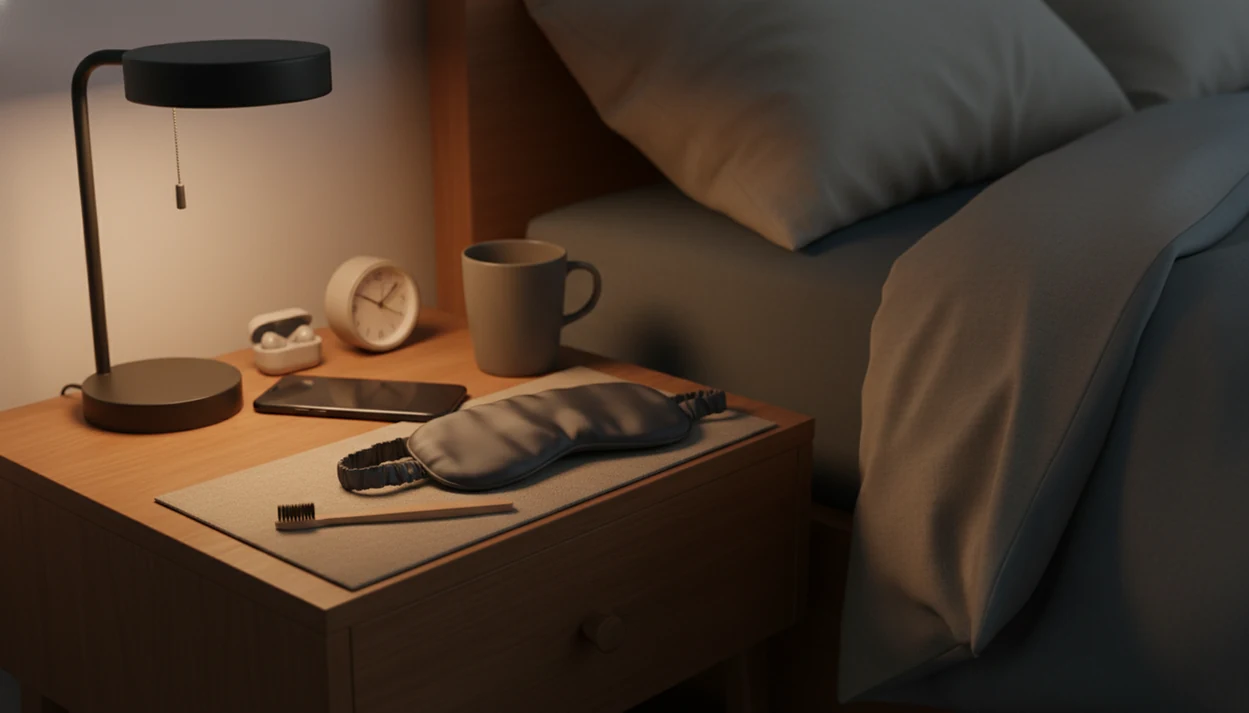
A habit stacking bedtime routine works by attaching sleep audio to a cue you already repeat every night, such as brushing your teeth, setting your alarm, or dimming the lights. Keep the stack small, predictable, and low-stimulation so the same cue-to-audio sequence becomes a reliable wind-down signal.
> Habit stacking for sleep means pairing a new bedtime habit with an existing routine cue so the old behavior automatically triggers the new one.
- Choose one stable nightly cue, then attach one calming audio action to it.
- Use the same order, similar sound, and consistent volume for several weeks.
- Keep the routine short enough to repeat even on tired, busy, or travel nights.
Habit stacking bedtime routine definition for sleep audio
Habit stacking for sleep means pairing a new bedtime habit with an existing routine cue so the old behavior automatically triggers the new one. For sleep audio, that new habit might be pressing play on a sleep story, guided meditation, or steady sleep sounds.
The cue should be something you already do without debate: brushing teeth, setting an alarm, plugging in your phone, or turning off the lights. The audio action comes right after it, not ten minutes later after another scroll.
A simple version looks like this: after I set my alarm, I start my sleep story at low volume. Bedside details matter here. A phone turned face down on the nightstand with the sleep timer already set is easier to repeat than a five-step app search.
Bedtime Adult is a bedtime stories for adults app that offers calming fiction, sleep meditations, and sleep sounds for grown-ups.
Why a bedtime habit matters for short sleep
A bedtime habit matters because short sleep is common, and most people need routines that survive normal work nights. The American Academy of Sleep Medicine and Sleep Research Society recommend at least 7 hours of sleep per night for adults source.
- Adults are generally advised to get at least 7 hours of sleep each night.
- Per the CDC, about 35% of U.S. adults report sleeping less than 7 hours on average source.
- Per the CDC, about 35% of U.S. adults report sleeping less than 7 hours on average source.
- Habit stacking is a behavior-design tool, not a cure for poor sleep or insomnia.
- For busy adults, a small cue-based routine is often easier than rebuilding the whole evening.
The monitor glow is gone from the desk. That is often the realistic starting point, not an ideal wellness schedule. If you want a shorter structure, a 10-minute bedtime routine for adults can give the stack a practical container.
How habit stacking sleep routines work in the brain
Habit stacking sleep routines work through a habit loop: an existing cue, a new behavior, and a repeated reward or state change. In plain language, your brain learns, “When this happens, the next thing is winding down.”
The order matters. If brushing teeth is always followed by low-volume rain, a calm narrator, and lights out, the sequence becomes familiar. Familiar is useful at night because it reduces decisions. Repetition over weeks matters more than one unusually tidy evening.
Low-stimulation audio can become a sensory cue for sleepiness when it stays boring in the right way. Soft rain, brown noise, and distant train ambience each create a different texture, but the chosen texture should not keep asking for attention.
Tiny, repeated cues carry the routine.
For adults who share a room, bedtime stories and sleep meditation for adults can deliver calming fiction, wind-down routines, and sleep sounds, family-safe, not 18+.
Before you build a bedtime habit stack
Before you build a bedtime habit stack, choose the parts that will still work on an ordinary tired night. The routine should fit your room, your household, and your actual bedtime window.
- Stable anchor habit: Pick one behavior that already happens most nights, such as brushing teeth or switching off a lamp.
- Realistic bedtime window: Use the time you usually move toward bed, not the time you wish you did.
- Low-stimulation audio: Choose family-safe bedtime audio with soft narration, steady pacing, or gentle sound.
- Playback method: Decide on speaker, headphones, or low-volume phone playback before you are half-asleep.
- Obvious blockers: Reduce late caffeine, bright screens, overheated rooms, and bedding discomfort where you can.
A partner may ask, “Can you turn it down one notch?” Build that into the plan. If household fit is the main issue, a bedtime routine app for adults can help separate grown-up sleep audio from children’s stories or general entertainment apps.
How to use a routine cue for bedtime audio
To use a routine cue for bedtime audio, connect one existing action to one audio action and repeat the same sequence nightly. Keep the stack so plain that you can do it after a long commute or a late family evening.
- Set one existing cue as the anchor, such as brushing teeth, setting your alarm, or plugging in your phone.
- Write an if-then formula: after I do the cue, I start the audio.
- Start the same audio type immediately after the cue, before checking messages or opening another app.
- Keep volume and playback length consistent, such as one 10-minute meditation or a 30-minute sleep story.
- Repeat nightly and adjust one variable at a time, such as cue, volume, audio length, or start time.
The thumb hovering over airplane mode is a useful moment. Make that the boundary. For people with irregular evenings, the most reliable habit stack is the one with the fewest choices after the cue.
Step 1: Choose one stable bedtime habit anchor
Which bedtime habit should I use as the anchor? Choose a behavior that already happens every night without much thought and occurs close enough to sleep that audio feels like the next natural step.
Good anchors include brushing teeth, setting an alarm, plugging in your phone, closing curtains, or switching off a bedside lamp. A bedside lamp dimmed at 10:15 p.m. is a stronger cue than a vague promise to “relax earlier.”
Weak anchors are inconsistent, social, or dependent on an app notification. “After my friend stops texting” is not stable. Neither is “after I feel tired,” because tiredness may arrive late or not feel obvious.
The anchor should sit near the sleep transition. If it happens at 7:00 p.m., the brain may treat the audio as evening entertainment rather than a wind-down cue. Close the gap. Make it boringly repeatable.
Step 2: Write an if-then habit stacking sleep formula
Use this literal structure: after I [existing cue], I will [audio action]. The formula turns a loose intention into a bedtime habit with a clear trigger.
Examples you can copy:
- After I set my alarm, I press play on my sleep story.
- After I plug in my phone, I start my nightly sleep sounds at low volume.
- After I turn off the lamp, I begin a 10-minute sleep meditation.
- After I close the bedroom door, I play brown noise for 30 minutes.
Specificity reduces decision-making at night. You do not need to decide between a podcast, a video, music, or silence when you are already tired.
Use one sentence. Not a whole plan.
Tools like Bedtime Adult can fit this formula when you want adult sleep stories, soft narration, or repeatable soundscapes in one place. The habit still comes from the cue, not from the app icon.
For this specific stack, Bedtime Adult works best as the repeated audio action: open one saved Sleep Story for Grown Ups, keep the volume low, and let the cue stay the trigger. Do not make browsing the app part of the habit.
Step 3: Match sleep audio to the bedtime habit
The audio should support relaxation instead of creating a new source of stimulation. Calm fiction, sleep meditation, and steady sleep sounds usually fit better than suspense, news, loud playlists, or highly variable talk shows.
| Audio choice | Better for | Use with this cue | Watch for |
|---|---|---|---|
| Calm fiction | Racing thoughts after work | After setting an alarm | Avoid dramatic plots |
| Guided meditation | Body tension or mental busyness | After turning off the lamp | Keep the voice calm |
| Rain or brown noise | Shared rooms or travel | After plugging in phone | Keep volume steady |
| Dramatic podcast | Entertainment | Not ideal as a sleep cue | Too much novelty |
A mindfulness meditation meta-analysis found moderate sleep-quality improvements in adults with sleep disturbance source. That supports relaxation-based practices, though it does not prove every audio routine will improve sleep.
A grown-up tale without childish voices feels different in the dark. Family-safe adult audio helps avoid both sing-song children’s content and erotic content, which keeps the stack partner-friendly and low drama.
Step 4: Repeat the bedtime habit stack for weeks
A bedtime habit stack usually needs weeks of repetition before it feels automatic. Consistency matters more than routine length, audio novelty, or doing a long wind-down on one good night.
Create a minimum version for difficult nights. That might be: set alarm, press play, lights out. No journal, no stretching, no complex sleep dashboard. Just the cue and the audio.
A checkmark on paper is enough for tracking. Record whether the cue happened, whether the audio started, and whether the evening felt easier to begin. The fan humming near the dresser may become part of the same sleep context, but do not measure everything in the room.
Missing one night is not failure. Restart with the same cue the next night.
For people testing a new routine, two weeks is a useful early review point; a 2 weeks bedtime routine can help you judge consistency before changing the stack.
Evidence Behind Habit Stacking Bedtime Routines
The evidence is strongest for the pieces: cues help habits form, repetition builds automaticity, and calm pre-sleep behaviors support a lower-stimulation bedtime. Evidence is more indirect for the exact combination of habit stacking plus sleep audio.
Habit-loop research supports using a stable cue, repeated action, and familiar reward state. Sleep hygiene guidance also tends to favor consistent bedtime behaviors, reduced stimulation, and a room routine that does not keep the brain problem-solving. Meditation and relaxation audio may help some adults settle attention or reduce tension, but that does not mean every story, soundscape, or app will improve sleep.
- Use the cue as the behavior trigger, not a reminder you can debate.
- Repeat the same audio style and timing long enough for it to feel familiar.
- Keep the content calm, predictable, and low-volume so it does not become entertainment.
- Treat the stack as a support habit, not a clinical treatment.
If insomnia is chronic, distressing, or tied to daytime impairment, CBT-I or clinical evaluation is more appropriate than adding more bedtime audio.
Common bedtime habit stacking mistakes with audio
Most bedtime habit stacking mistakes come from making the routine too interesting, too long, or too dependent on conditions you cannot control. The goal is a repeatable wind-down cue, not a polished evening performance.
- Adding too many steps too soon makes the routine fragile on late or stressful nights.
- Changing audio style every night weakens the cue because the brain keeps meeting something new.
- Using stimulating podcasts, dramatic fiction, or loud playlists can keep attention active.
- Depending on an unstable cue, such as a notification or another person’s schedule, makes repetition harder.
- Expecting instant sleep turns a conditioning practice into a nightly performance test.
Sleep basics still matter. Habit stacking cannot cancel out late caffeine, irregular schedules, bright screens, or a room that is too hot. Clinicians typically recommend sleep hygiene basics alongside behavioral sleep strategies, especially when poor sleep is ongoing or distressing.
The stack should feel almost dull. That is the point.
How to verify your habit stacking bedtime routine works
Verify a habit stacking bedtime routine by looking for easier routine initiation, calmer evenings, and less decision fatigue over two to four weeks. Do not judge the whole method by one night of sleep latency.
Track three simple signals: cue completed, audio started, and perceived wind-down. Use a checkmark or a one-word note. “Settled” is enough. If you start building charts, the routine may become another screen task.
Structured sleep routines appear in broader digital insomnia interventions, including digital cognitive behavioral therapy for insomnia source. However, a bedtime audio stack is not medical treatment and should not be presented as one.
Adjust one element at a time. Change the cue, audio length, volume, or start time, then leave the rest alone for several nights. For longer experiments, a bedtime routine benefits after 30 days frame can help separate early friction from a routine that genuinely does not fit.
Limitations
Habit stacking with bedtime audio has real limits. It can support a repeatable wind-down routine, but it should not be treated as a treatment plan for chronic insomnia, trauma symptoms, or a sleep disorder.
- Habit stacking is a behavior-design tool, not medical care for chronic insomnia or suspected sleep disorders.
- People with PTSD, anxiety disorders, or trauma histories may find some voices, stories, or sounds activating.
- The method depends on having at least one stable nightly cue; chaotic evenings make the stack harder.
- Evidence specific to habit stacking plus audio is limited; support comes from broader habit, sleep hygiene, meditation, and routine research.
- Audio cannot compensate for late caffeine, irregular schedules, bright screens, pain, noise, or an uncomfortable room.
- Over-reliance on one app, narrator, or story can become a crutch when traveling or offline.
- Shared bedrooms require consent and volume control; partner-friendly listening is not automatic.
If sleep problems last for weeks, cause distress, or affect daytime functioning, it is sensible to speak with a clinician.
FAQ
What is bedtime habit stacking?
Bedtime habit stacking means attaching a new sleep-friendly action to an existing bedtime cue. For example, after you brush your teeth, you start a low-volume sleep story.
Does habit stacking help sleep?
Habit stacking can support consistency and make winding down easier. It is not an instant sleep fix or a substitute for medical care.
What is a routine cue?
A routine cue is an existing behavior that triggers the next action in your bedtime routine. Setting an alarm, plugging in your phone, or turning off a lamp can all work.
Which bedtime cue works best?
The best bedtime cue is stable, nightly, and close to sleep because it gives the brain a reliable signal. Brushing teeth, setting an alarm, and turning off lights are common choices.
Can audio become a sleep cue?
Yes, repeated low-stimulation audio can become associated with winding down. Keep the audio style, volume, and timing similar for several weeks.
How long should sleep audio play?
Choose a length you can repeat consistently, such as 10, 20, or 30 minutes. Bedtime Adult and similar apps may offer timers, but the important point is consistency.
Why is my bedtime habit stack failing?
Common reasons include too many steps, a weak cue, stimulating audio, inconsistent timing, or expecting instant sleep. Change one variable at a time before abandoning the routine.
Is habit stacking an insomnia treatment?
No, habit stacking is not an insomnia treatment. If sleep problems are chronic, distressing, or affect daytime functioning, seek professional evaluation.