
Sleep Stories for Hotel Travel and Unfamiliar Rooms
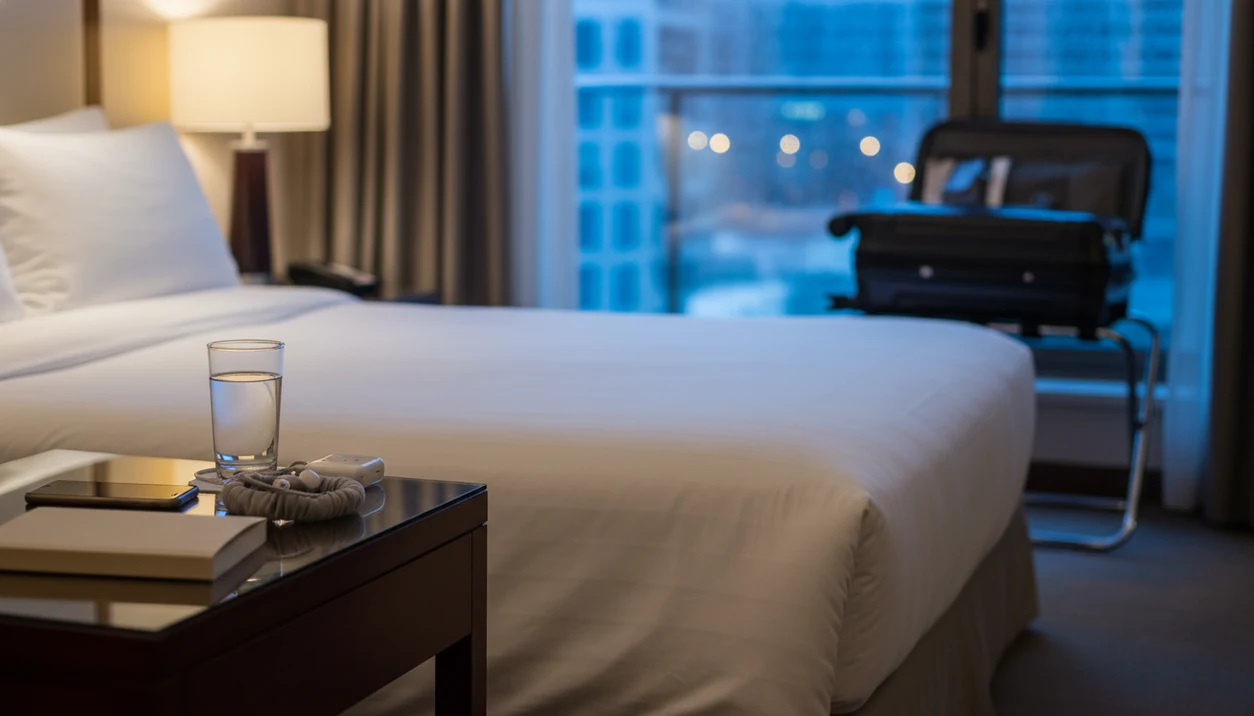
Sleep stories for hotel travel work best when you make them part of a repeatable hotel bedtime setup: download the audio before arrival, keep the volume low, pair narration with steady rain or soft ambience, and remove screen light from the room. The goal is not to force sleep, but to make an unfamiliar hotel room feel predictable enough for your brain to wind down.
> Hotel sleep stories are calm spoken bedtime stories, sleep meditations, or gentle fiction tracks used as sleep audio in hotels to reduce nighttime alertness and make unfamiliar rooms feel more familiar.
- Download one or two hotel sleep stories before you travel so Wi-Fi or roaming problems do not break the routine.
- Choose slow, low-tension narration and keep the volume just loud enough to cover hallway, HVAC, or traffic noise.
- Use the same travel bedtime routine each night: dim lights, set temperature, start audio, turn the screen away, and let the story become a sleep cue.
Hotel Sleep Stories At A Glance
A strong hotel sleep story setup is simple: downloaded audio, low volume, minimal screen light, and consistent playback each night. That setup works better than searching for something new while tired.
Sleep audio is already mainstream. A 2023–2024 Sleep Foundation survey found that 63% of Americans use some form of audio to help them sleep, according to its source. In a hotel, the useful version is quiet and predictable, not dramatic.
A phone propped on a travel adapter is still a screen, so turn it away once the timer is set. Bedtime Adult can fit this use case because its library includes calming fiction, sleep meditations, and sleep sounds for grown-ups. It is family-safe bedtime audio for grown-ups, not erotic, clinical, or children’s content.
How Sleep Stories for Hotel Travel Work
Hotel sleep stories are calm spoken bedtime stories, sleep meditations, or gentle fiction tracks used as sleep audio in hotels to reduce nighttime alertness and make unfamiliar rooms feel more familiar.
Unfamiliar rooms can raise alertness because the brain is checking new signals: hallway doors, bedding texture, light under the door, HVAC cycles, and where the bathroom is. Sleep researchers often describe this as environmental monitoring. In plain terms, part of you keeps listening.
One sleep-lab explanation is the first-night effect, where unfamiliar environments can keep part of the brain more responsive during sleep; see the Current Biology study at https://www.cell.com/current-biology/fulltext/S0960-9822(16)30174-9.
A sleep story gives the brain a steadier target. Slow narration, low emotional stakes, and soft ambience can reduce the pull toward TV, scrolling, or listening for every sound outside the room. The same voice or soundscape can also become a wind-down cue over repeated nights.
Small cues matter.
Sleep stories may support general relaxation, but they are not a medical treatment for insomnia or jet lag. Calming fiction, wind-down routines, and sleep sounds can make bedtime feel safer and more familiar, not deliver adult content or clinical sleep therapy.
Sleep Audio Hotel Requirements Before Check-In
Prepare hotel sleep audio before check-in because the hardest moment to fix tech is after midnight. A red-eye cabin with the lights dimming overhead is not the time to discover your app logged out.
- Download stories, meditations, and sleep sounds before travel because hotel Wi-Fi, roaming, and app logins can fail.
- Pack a charged phone, charger within reach, wired earbuds or comfortable sleep headphones, and an optional small speaker.
- Set a backup alarm outside the sleep app, especially for early meetings or airport transfers.
- Prepare the room with a dim screen, do-not-disturb sign, blackout curtains, comfortable temperature, and low notification settings.
- Protect sleep opportunity: the CDC says adults need 7 or more hours of sleep per night on a regular basis for optimal health, per its source.
For broader travel planning beyond hotels, the routine ideas in sleep stories for travel can help you keep one cue across flights, guest rooms, and rentals.
How To Use Sleep Stories For Hotel Travel
Use sleep stories for hotel travel as a short routine, not a late-night content hunt. For work trips, this is often easier than improvising because each step removes one decision.
- Download two calm stories and one soundscape before leaving home.
- Set the room first, including curtains, temperature, alarm, charger, and do-not-disturb sign.
- Choose a low-tension story with slow pacing and a familiar narrator.
- Pair the story with rain, fan, or soft ambience only if it helps mask noise.
- Turn the screen away, keep volume low, and avoid restarting or browsing if still awake.
A bedside lamp dimmed at 10:15 p.m. can become part of the cue. So can plugging in the phone, checking the alarm once, and leaving the next day’s clothes on the chair.
No more choices.
For busy travelers, sleep stories usually work best when they are attached to a fixed pre-sleep sequence, while open-ended browsing fits people who are still in entertainment mode.
Best Hotel Sleep Stories For Noisy Rooms
The best hotel sleep stories for noisy rooms are steady, low-tension tracks that do not spike in volume or plot intensity. Loud audio is not better; stable audio is usually safer for sleep and kinder to nearby rooms.
| Hotel noise problem | Better audio choice | Avoid |
|---|---|---|
| Hallway doors | Calm fiction with rain underneath | Suspense or cliffhangers |
| Elevator traffic | Gentle guided narration | Voices that change intensity |
| City streets | Rain, fan, or brown noise under narration | News or true crime |
| HVAC hum | Soft ambience alone or under a story | Loud peaks |
| Neighboring rooms | Low, steady narration through earbuds | Speaker volume that carries |
| Unfamiliar silence | Slow story with a familiar voice | Comedy or dramatic plots |
If anxious alertness is the issue, gentle narration may help more than pure sound. If the problem is only a low mechanical hum, a soundscape may be enough. The full light-sleeper version is covered in sleep audio for light sleepers.
Travel Bedtime Routine For Unfamiliar Hotel Rooms
How should you build a travel bedtime routine in an unfamiliar hotel room? Pair the story with basic sleep hygiene: light control, temperature control, less late caffeine or alcohol, and predictable pre-sleep cues.
A useful sequence is plain: unpack essentials, set tomorrow’s clothes, plug in the phone, dim the lights, start the story, then stop decision-making. The monitor glow gone from the desk is a different room signal than a laptop open beside the pillow.
Pew’s 2024 sleep data found that only 44% of U.S. adults usually get at least 7 hours on weekdays or workdays, compared with 62% on weekends or non-workdays, according to the Pew Research Center: https://www.pewresearch.org/short-reads/2024/01/25/how-americans-view-sleep/. Work travel can squeeze that window even further.
The goal is friction reduction, not a perfect hotel sleep environment. If your main issue is post-work rumination, bedtime stories for busy professionals may be the closer routine match.
Hotel Sleep Stories Compared With TV, White Noise, And Scrolling
Hotel sleep stories can be a better wind-down option than TV or scrolling because they give structure without visual stimulation. Still, some people prefer pure sound because spoken narration can feel distracting.
| Option | What it helps | Main drawback in hotels |
|---|---|---|
| Sleep stories | Narrative focus, comfort, routine | Plot or voice can distract some listeners |
| Late-night TV | Familiar background presence | Light, ads, volume jumps, cliffhangers |
| Social scrolling | Short-term distraction | Novelty loops and bright screens |
| White noise | Masks steady sound | Little emotional focus |
| Podcasts | Familiar voices | Topics may become too interesting |
| Silence | No device needed | Can make hallway noise feel louder |
For many travelers, calm stories are easier than TV because they remove images and choices. White noise fits people who only need masking, while narration fits people whose thoughts keep checking the room.
Common Sleep Audio Hotel Mistakes
Most sleep audio hotel problems come from setup choices, not from the idea of bedtime audio itself. The fix is to reduce novelty before you get into bed.
Streaming without downloads. Hotel Wi-Fi can stall right when the timer starts. Save at least one story and one soundscape offline.
Volume too high. Loud peaks can wake you or disturb others through thin walls and connecting doors. Partner-friendly listening matters in shared rooms too, as in sleep stories for couples.
Starting a new exciting series. Repeated content is often better than novelty because you do not need to track plot details.
Using bright screens. Set the track, then turn the phone face down on the nightstand.
Forgetting battery life. Bluetooth, streaming, and alarms all need power.
Changing narrators nightly. A familiar voice is a stronger cue than a nightly audition. If a track fails, switch once to a backup soundscape. Don’t troubleshoot endlessly in bed.
Sleep Story Setup Check Before Lights Out
Use this as the final verification check before lights out. The right setup should feel boring, quiet, and already decided.
- Audio is downloaded, not only available to stream.
- Volume is tested: audible enough to follow without effort, quiet enough that it fades into the room.
- Charger is connected, alarm is set, and notifications are silenced.
- Room is darkened, temperature is adjusted, and the do-not-disturb sign is out.
- Story is queued before you get under the covers.
Pew’s 2024 sleep-quality data found that 33% of adults usually sleep very well on weekdays or workdays, versus 57% on weekends or non-workdays. That gap is one reason work travelers should protect the setup before they are tired.
Earbuds resting in their small case are fine. Just decide before the lights go out.
Limitations
Sleep stories can support general relaxation, but they are not proven to cure insomnia and are not a substitute for medical care. Clinicians typically recommend discussing persistent sleep problems with a qualified health professional, especially when poor sleep affects daytime function.
- Sleep stories may not overcome severe jet lag, because circadian rhythm timing is different from bedtime relaxation.
- Loud neighboring rooms, unsafe conditions, or disruptive hotel events may need a room change, not audio.
- Poor blackout curtains, uncomfortable bedding, or bad temperature control can still interrupt sleep.
- Some travelers find spoken narration distracting, especially when the plot gets interesting or the narrator changes tone.
- Bluetooth, streaming apps, hotel Wi-Fi, and battery life can fail without offline backups.
- What works in one hotel may not work in another because acoustics, bedding, temperature, and noise vary.
- If bedtime audio increases frustration, stop adjusting it in bed and return to a simpler cue.
Apps such as Bedtime Adult, Calm, Headspace, and Get Sleepy can offer useful options, but the routine still has to fit the room and the listener.
FAQ
Do sleep stories work in hotel rooms?
Sleep stories can help some travelers relax in hotel rooms, especially when used as part of a repeated routine. They do not work for everyone and should not be treated as a cure for insomnia.
What volume should I use for a hotel sleep story?
Use a low, steady volume that is audible without effort but quiet enough to fade into the background. If someone outside the bed can clearly follow the story, it is probably too loud.
Should I download sleep stories before hotel travel?
Yes, offline downloads are recommended before hotel travel because Wi-Fi, roaming, and streaming logins can fail. Download at least two stories and one soundscape before leaving home.
Are headphones or speakers better for sleep stories in hotels?
Headphones, sleep headbands, and earbuds give more privacy and reduce disturbance to others. A small speaker can work at very low volume, but hotel walls and connecting doors may carry sound.
Can sleep stories help with jet lag in a hotel?
Sleep stories may support relaxation during jet lag, but they do not reset circadian rhythm or cure jet lag. Light timing, schedule changes, and travel direction also matter.
Are rain sounds enough for sleeping in a noisy hotel?
Rain sounds may be enough when the main problem is steady background noise. Spoken narration may help more when anxious thinking or unfamiliar silence keeps attention active.
What kinds of stories are too stimulating before bed?
Suspense, comedy, news, true crime, cliffhangers, and fast-paced plots are often too stimulating before bed. Choose slow stories with low stakes and stable narration.
Can kids hear adult sleep stories in a hotel room?
Bedtime Adult content is family-safe and designed for grown-ups, not children’s bedtime programming. In a shared hotel room, preview content and keep volume low.