
Sleep Stories And Trauma: Choosing Gentler Audio
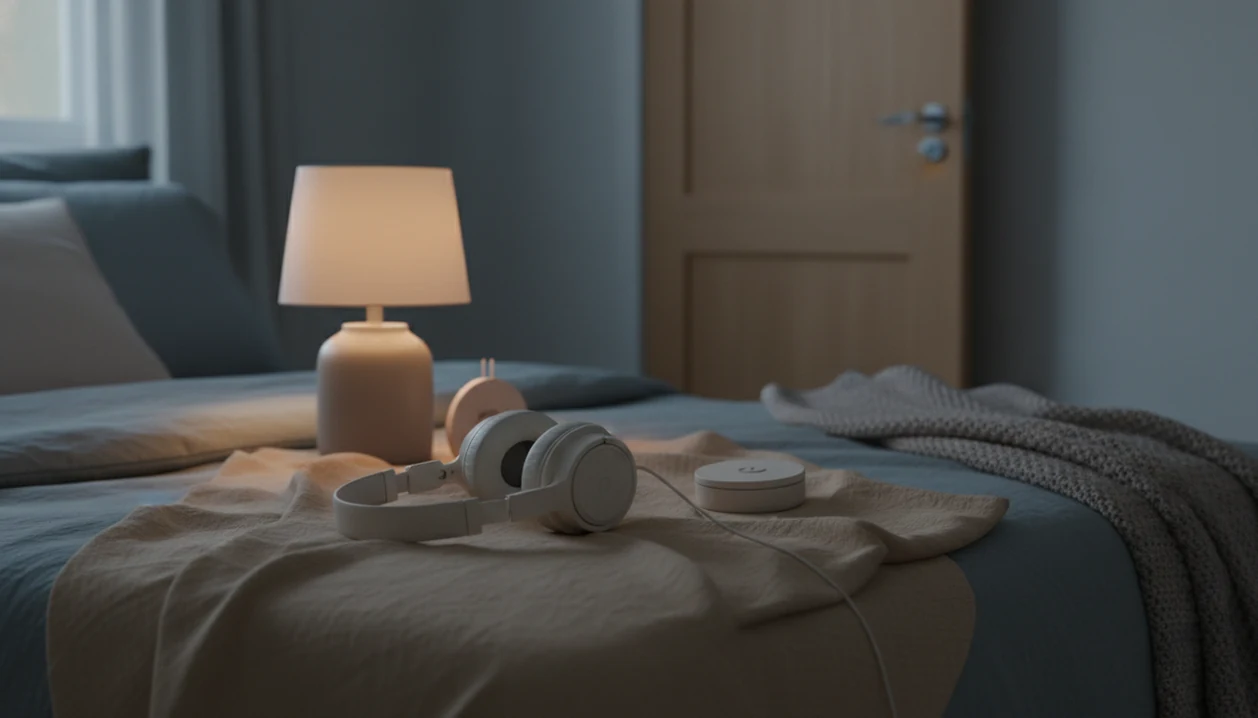
Sleep stories and trauma need extra care: choose slow, predictable, low-drama audio that gives you control over voice, volume, topic, and stopping. A gentle track can support a calmer bedtime, but it should not be treated as therapy or a cure for PTSD, nightmares, or insomnia.
This page is educational and is not a substitute for diagnosis, trauma therapy, medical care, or crisis support. If bedtime feels unsafe, symptoms are escalating, or you may harm yourself or someone else, seek urgent professional or emergency help instead of using audio alone.
> Trauma-safe sleep stories are softly narrated, predictable bedtime audio tracks designed to avoid common activating themes and support a sense of safety for adult listeners.
- Look for gentle bedtime audio with calm narration, steady volume, no suspense, and clear topic descriptions.
- Avoid sleep audio triggers such as violence, medical emergencies, sudden loss, abrupt sound effects, and spatial audio that feels too close.
- If sleep problems, nightmares, or PTSD symptoms are severe, use sleep stories only as self-care support and consider professional help.
What sleep stories and trauma-sensitive audio should mean
Trauma-sensitive sleep stories are adult bedtime audio tracks built around predictability, low emotional intensity, and listener control. They are not children’s stories, erotic audio, or treatment for trauma.
A useful sleep story sounds slow on purpose. The plot does not chase danger. The narrator does not perform fear, grief, or shock. Good bedtime stories and sleep meditation for adults deliver calming fiction, wind-down routines, and sleep sounds, family-safe, not 18+ content or clinical care.
Individual triggers vary. A seaside inn scene behind closed eyes may feel peaceful to one listener and unsafe to another if it carries a personal association. That is why volume, pause, skip, topic labels, and an easy stop button matter.
Bedtime Adult is a bedtime stories for adults app that offers calming fiction, sleep meditations, and sleep sounds for grown-ups.
Five facts about trauma, PTSD, and sleep audio triggers
Here are the core facts to keep in mind before choosing sleep audio after trauma:
- PTSD and trauma can disrupt sleep through insomnia, nightmares, fragmented sleep, night sweats, and feeling on edge after the lights go out.
- About 50–90% of people with PTSD report sleep disturbances, including insomnia and nightmares, according to a 2018 review in Nature and Science of Sleep (https://pmc.ncbi.nlm.nih.gov/articles/PMC6309693/).
- In a national U.S. study cited in that review, 70–91% of people with PTSD reported trouble initiating or maintaining sleep, and 19–71% reported nightmares (https://pmc.ncbi.nlm.nih.gov/articles/PMC6309693/).
- Sleep is involved in emotional memory processing, so intense words, sounds, or storylines at bedtime can stir memories rather than settle them; see the Sleep Foundation’s overview of sleep and memory for general context (https://www.sleepfoundation.org/how-sleep-works/memory-and-sleep).
- Sleep stories are self-care tools for general relaxation. They are not medical treatment for PTSD, complex trauma, severe insomnia, or recurring nightmares.
The most common medically supported way to address trauma-related sleep symptoms is professional care combined with safer sleep hygiene basics, not audio alone. A phone face down on the nightstand can help, but it cannot replace care when symptoms are heavy.
How trauma safe sleep stories work at bedtime
Trauma safe sleep stories work by lowering alerting cues before sleep. Predictable narration, slow pacing, steady sound, and low-stakes plots give the brain fewer reasons to scan for threat.
The nervous system can react to danger signals in sound, story, voice, or surprise. A sudden whisper near one ear, a chase scene, or music that swells without warning may feel like an alarm. That response is not overreacting. It is a body trying to protect itself.
Low-conflict stories reduce cognitive load, which means the listener does not have to track danger, solve a mystery, or brace for a twist. A simple garden walk or quiet library scene asks less from the mind.
Some people do better with no story at all. Soft rain, brown noise, or distant train ambience may give enough structure without narrative content.
Gentle bedtime audio features that feel safer
Gentle bedtime audio usually feels safer when the track is easy to understand, easy to predict, and easy to stop. The feature set matters as much as the story idea.
- Soft narration: Choose a calm adult narrator with a warm but neutral tone, not a sing-song children’s voice or highly emotional acting.
- Even pacing: Look for slow sentences, simple language, and a steady volume that does not jump during scene changes.
- Predictable topics: Nature walks, cozy rooms, stargazing, libraries, gardens, and gentle fantasy often carry less threat than suspense or conflict.
- Clear controls: Summaries, content labels, favorites, sleep timers, and volume controls help you decide before the bedside lamp goes off.
Tools like Bedtime Adult can fit this role when you want a family-safe bedtime stories for adults app with calming fiction, sleep meditations, and sleep sounds for grown-ups. Shared bedrooms need that clarity, especially when a partner asks, “Can you turn it down one notch?”
Sleep audio triggers to screen before listening
Sleep audio triggers can come from story content, sound design, or surprise. Screen the track before bedtime, and stop at the first sign that your body is bracing.
| Screen for | Examples to avoid | Gentler alternative |
|---|---|---|
| Threat themes | Violence, abuse, war, pursuit, confinement | Nature walk, library, garden, quiet travel |
| Crisis scenes | Medical emergencies, sudden loss, intense grief | Low-drama daily rituals or soft fantasy |
| Sound jumps | Abrupt volume changes, sharp effects, sudden music | Steady narration with minimal production |
| Voice closeness | Whispers, breathy delivery, audio behind the listener | Clear narration at a comfortable distance |
| Plot surprise | Twists, hidden danger, unresolved conflict | Predictable beginning, middle, and ending |
A surprise plot twist can be triggering even when the first ten minutes sound calm. If your shoulders rise or your breathing changes, switch tracks. No need to push through.
For broader content boundaries, our guide to safe bedtime stories for adults explains how family-safe story choices differ from vague “relaxing” labels.
Pre-bed screening questions for trauma safe sleep stories
“Is this track likely to feel safe when I am tired, alone, and less able to filter it?” Ask that before pressing play, not after the room is dark.
Read the title, description, and content warnings first. If the summary is vague, test-play the middle during the day or earlier in the evening. The middle is where many stories introduce tension.
Questions about story content
Does the story include danger, separation, illness, confinement, grief, or someone being followed? Does it resolve gently, or does it leave tension hanging? For trauma-sensitive listeners, a predictable low-stakes story is often easier than a dramatic meditation because the body does not have to wait for the next emotional turn.
Questions about sound design
Does the narrator’s voice, accent, closeness, or emotional tone feel comfortable? Can you pause, lower volume, change tracks, or switch to nature sounds without looking at a bright screen?
Small controls count. A sleep timer set before the weighted blanket is pulled up can make the whole routine feel less exposed.
When gentle bedtime audio is not enough
Gentle bedtime audio may help with winding down, but it does not treat PTSD, complex trauma, major depression, or severe insomnia. Clinicians typically recommend assessment and targeted care when trauma-linked sleep symptoms persist or worsen.
Consider professional support if you have recurring nightmares, panic at bedtime, fear of sleep, dream enactment, severe exhaustion, or symptoms that are getting worse. Trauma-associated sleep disorder has been described as involving recurrent trauma-themed nightmares and dream enactment behaviors, which is more than ordinary restless sleep. For clinical background on trauma-associated sleep disorder and trauma-themed dream enactment, see the original proposed parasomnia description in Journal of Clinical Sleep Medicine (https://pubmed.ncbi.nlm.nih.gov/25406295/).
If safety is at risk, contact a qualified health professional, crisis support, or local emergency services. Audio should be the small support, not the whole plan.
A related insomnia boundary is covered in when to see a doctor for insomnia. For trauma symptoms, it is especially important not to wait until bedtime feels unmanageable every night.
Sources and review standards
This guidance is based on established PTSD, sleep medicine, and public-health sources, but it is educational only. It is not a diagnosis, treatment plan, therapy protocol, or substitute for a qualified clinician.
The source base includes PTSD and trauma guidance from clinical and public-health organizations, sleep medicine literature on insomnia, nightmares, parasomnias, and sleep hygiene, and broader public-health safety guidance for crisis and emergency situations. Because direct evidence on sleep stories as a trauma-specific tool is still limited, this page applies cautious principles from related areas rather than claiming that audio can treat trauma symptoms.
Our review process is designed to keep the advice calm, bounded, and practical:
- Check medical claims against PTSD, sleep medicine, and public-health guidance.
- Review wording for trauma-sensitive language, avoiding blame, pressure, or “push through it” framing.
- Keep safety boundaries clear when symptoms are severe, worsening, or linked to self-harm risk.
- Update the page when new clinical guidance, major sleep-medicine evidence, or safety recommendations change.
Last reviewed: March 2026. Earlier review is triggered by new PTSD sleep guidance, major nightmare-treatment recommendations, app-safety concerns, or updated crisis-care standards.
Limitations
Sleep stories can be useful, but the evidence and safety boundaries are limited. Treat them as one gentle option inside a wider support plan.
- There is limited direct research on trauma-safe sleep stories as a specific intervention.
- Most guidance is adapted from broader trauma, sleep, PTSD, relaxation, and audio-design evidence.
- No story can be guaranteed trigger-free because personal associations vary.
- Narrative content may keep some people alert, making white noise, brown noise, rain, or simple nature sounds better.
- Over-reliance on one narrator, app, or track can make sleep harder in hotels, hospitals, or other new environments.
- Sleep stories should not replace trauma therapy, medical care, or evaluation for persistent nightmares.
- Privacy matters if you use an app at night; review sleep app privacy before saving sensitive routines or listening data.
For some listeners, silence is safer. That is a valid choice, not a failed routine.
FAQ
Are sleep stories trauma safe?
Some sleep stories are gentler for trauma-sensitive listeners, but no sleep story is automatically safe for every trauma history. Screen the topic, narrator, sound design, and controls before bedtime.
Can sleep stories trigger PTSD?
Yes, certain sounds, themes, voices, or surprises may be activating for some people with PTSD or trauma histories. Stop or switch audio if distress starts.
What makes bedtime audio gentle?
Gentle bedtime audio usually has slow pacing, steady volume, soft narration, predictable topics, and low emotional intensity. Clear descriptions and easy controls also help.
Should I avoid scary stories?
If you are trauma-sensitive, avoid horror, suspense, violence, threat, and unresolved conflict at bedtime. Choose low-drama stories or non-narrative sounds instead.
Are nature sounds better?
Nature sounds may be better for listeners who find stories mentally activating. Rain, ocean sound, brown noise, or simple wind ambience can provide a calmer cue.
Can sleep stories stop nightmares?
Sleep stories are not a nightmare treatment. Recurring nightmares, especially trauma-themed nightmares, may need professional support.
Should I push through discomfort?
No. If audio starts to feel distressing, stop it, lower the volume, switch tracks, or use silence.
When should I get help?
Get help if you have severe insomnia, recurring trauma nightmares, panic at bedtime, fear of sleep, unsafe feelings, or worsening symptoms. Bedtime Adult and similar tools can support a routine, but they are not emergency or clinical care.